

In my previous piece, I wrote about totalitarianism, George Orwell, Big Brother, Brazil’s revolutionary Pix payment system, the decline of cash, and the expanding reach of the state’s all-seeing eye. Pix transactions and the obligation for financial institutions to report “significant” operations to the tax authorities — with “significant” defined entirely by the government — are not the only instruments of this new visibility. Perhaps even more important is the CPF.
The CPF (Cadastro de Pessoas Físicas) is Brazil’s central identification number, administered by the Receita Federal. Introduced in 1968 as a bureaucratic tool for income tax administration, it has since evolved into the absolute digital backbone of Brazilian life. What was once a small plastic card tucked into a wallet is now fully digitized and integrated into the new national identity card, the CIN (Carteira de Identidade Nacional). The system is so deeply embedded in society that nearly every Brazilian knows their eleven digits by heart. It is required not only for every official procedure but also as the most common “key” for the lightning-fast Pix payment network. Reciting the number at a checkout counter or typing it into a smartphone has become a reflex — a seamless merging of civic identity and daily consumption.
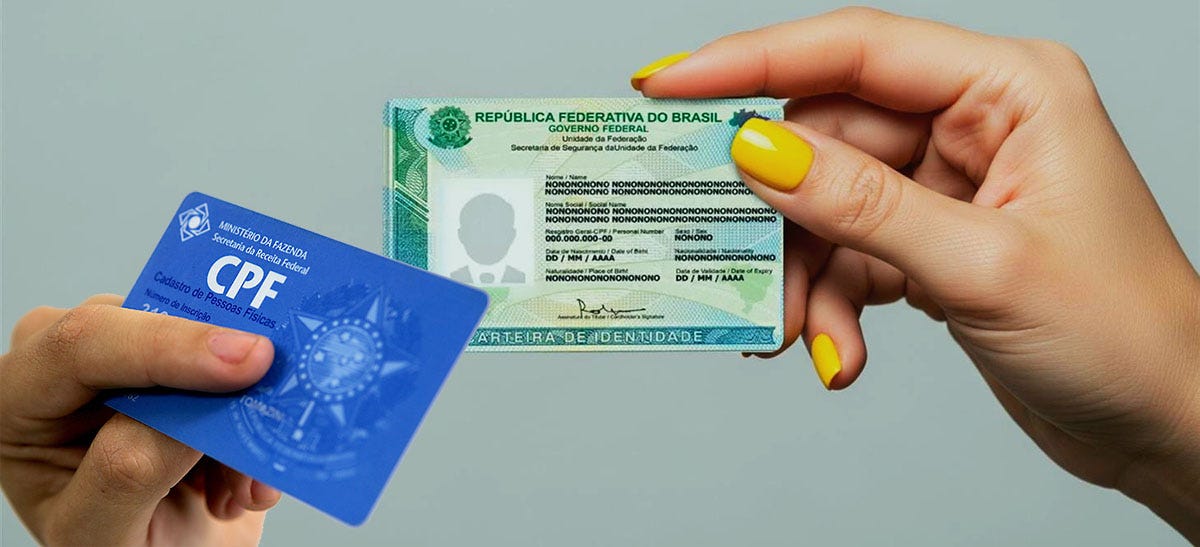
Through this evolution, the CPF has become the ultimate instrument of state control. It has long been known that life in Brazil is nearly impossible without a CPF, but the dependency has intensified. Today, the number is requested for almost every purchase, creating a level of traceability that has few parallels anywhere in the world.
A comparison with the Low Countries
Belgium has the Rijksregisternummer. It is used by the government, hospitals, and banks — but the idea of a supermarket or clothing store asking for it at the checkout is unthinkable. GDPR explicitly forbids such use for commercial purposes.
The Netherlands has the Burgerservicenummer (BSN). It is strictly reserved for government and healthcare. A retailer is not even allowed to copy or store it. If a Dutch cashier asked for your BSN, you would assume it was a joke or an attempted identity scam.
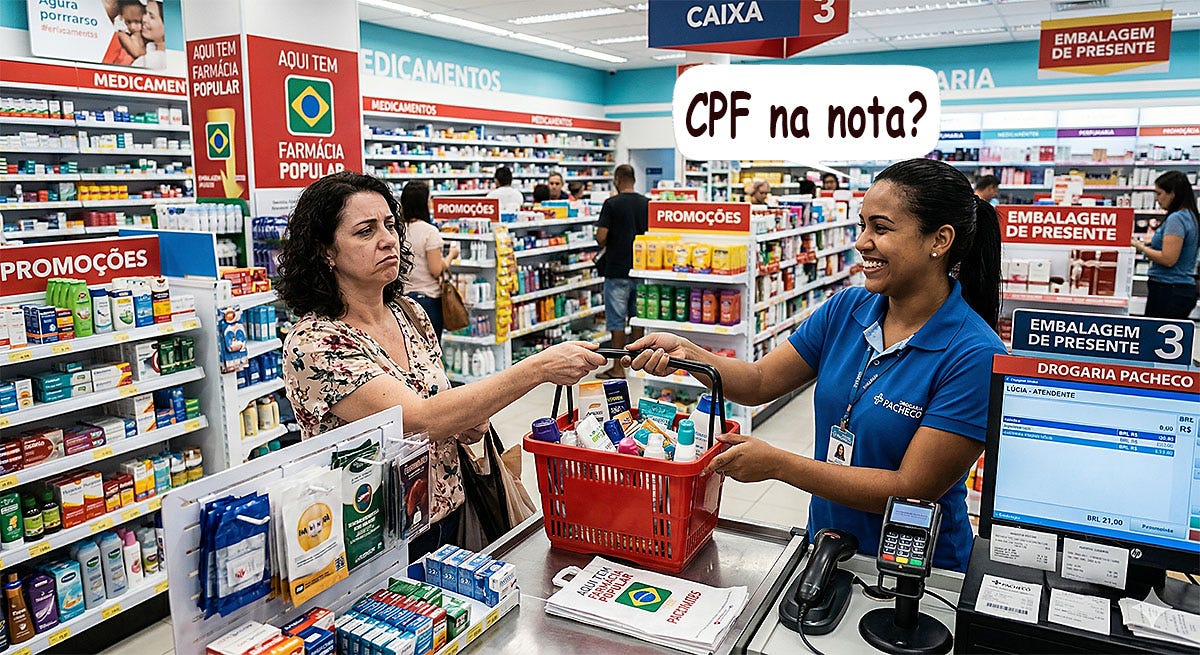
Brazil is a different universe. The CPF has evolved from a tax number into a universal digital key that logs virtually every economic interaction. The question “CPF na nota?” (“Would you like your CPF on the receipt?”) is heard more often than “Bom dia, tudo bem?” Officially, programs like Nota Fiscal Paulista encourage this by offering small tax refunds or lottery entries. In practice, it gives the tax authority a real-time map of your spending habits. Pharmacies take it even further: you often receive the “real” discount only after providing your CPF. This creates a shadow archive of your medical history and consumption patterns — data that, reportedly, is of great interest to health insurers.
To illustrate: yesterday I bought several (unfortunately expensive) medications at a local pharmacy. The total came to more than R$ 900 (€150). After giving my CPF, the price dropped to R$ 535 (€90).
Without a CPF, you can hardly function. Buying a SIM card, receiving a package from Mercado Livre, creating an account on a delivery app, even reserving a cinema ticket online — everything requires those eleven digits. While much of the world is still debating the privacy implications of website cookies, Brazil has built a system in which the physical world is as traceable as the digital one. In most countries, there is a strict separation between your “civic identity” (government) and your “consumer identity” (retail). In Brazil, that boundary has nearly vanished through the CPF and its integration with Pix. The number has become a sharp camera. The state sees not only what you earn, but also what you do with it. Extracting every last cent of tax revenue becomes effortless.
Credit scoring
The CPF is linked to credit-monitoring institutions such as SPC and Serasa. Because your CPF is recorded with nearly every purchase — and with every missed payment — the government (and the financial sector) maintains a real-time profile of your reliability. A “dirty” CPF (nome sujo) means social exclusion: you cannot sign up for subscriptions, rent an apartment, or, in some cases, even get hired for a job. It is a digital identity in which your moral standing and your financial behavior are inseparable.
Everyone knows who I mean when I refer to Big Brother. But the real executor is the commercial sector. When a pharmacy chain asks for your CPF “to give you a discount,” they are building a medical profile. What happens to that data? In the EU, GDPR would crush such practices instantly. In Brazil, enforcement of the LGPD — the Brazilian privacy law — is still young. There is a real fear that this information will eventually flow to insurers who adjust your premiums because your CPF history shows frequent purchases of medication for a chronic condition.
Resistance
Resistance to this evolution in Brazil is surprisingly muted, almost resigned. In Europe, even minor changes to privacy legislation spark parliamentary debates and lawsuits from civil-rights organizations. In Brazil, the CPF culture is often accepted with a shrug — a “necessary evil” for progress and security.
And it does not stop with pharmacy “blackmail.” In many modern office towers in Rio de Janeiro, São Paulo, or Salvador, you cannot even enter the elevator without registering your CPF at reception. Your physical movement through private space becomes directly linked to your fiscal identity.
Interestingly, both left and right embrace this digitalization. The left sees it as a tool to combat tax evasion among the wealthy and to distribute social benefits (such as Bolsa Família) more efficiently. The right sees it as a way to streamline government and fight fraud. Civil liberties fall through the cracks. Determined citizens can file complaints with Procon (the consumer-protection agency). If a store refuses to sell a product without a CPF, that is technically illegal (venda casada or discrimination). But pursuing such cases requires time and energy.
And you?
For a non-Brazilian who wants to stay, work, or invest in the country, the CPF is no longer optional — it is an existential requirement. Where a tourist once managed with a passport and some cash, the modern visitor hits a digital wall. Anyone investing in Brazilian real estate or the stock market is immediately absorbed into the system. Since 2025 and 2026, the rules for non-residents have been simplified, but the CPF link is unbreakable. Every rental payment, every dividend, every asset sale is reported in real time to the Receita Federal. The anonymity of the foreign investor no longer exists.
On the other hand
Brazil is a laboratory for the rest of the world. The integration of Pix with the CPF has created an ecosystem where payments are faster and more secure than in Europe. Companies that build on this infrastructure — tax-management software, digital-security platforms — are booming.
For foreign investors, corruption is often the biggest fear. In a system where every centavo is traceable through CPF and Pix, it becomes far harder for dubious partners to siphon off funds. The same “digital camera” that follows the citizen protects the investor from shady intermediaries.
The choice
You can remain outside the system and accept that you will be a “limited” visitor who constantly runs into walls. Or you can embrace the CPF and become a fully transparent citizen in exchange for unprecedented commercial speed and opportunity.
Brazil shows that the future of investing does not lie in avoiding the state, but in integrating seamlessly with its systems. For those accustomed to the relative anonymity of European banking, this is a shock. But for the investor focused on speed and returns, Brazil’s “fiscal lens” may be the most reliable partner they will ever have.
Illustrations AI generated
This section is published in English. More English posts will appear here as this section grows. Interface elements may appear in Dutch because the main publication is bilingual.
Stay updated. Click below to subscribe — free of charge.