

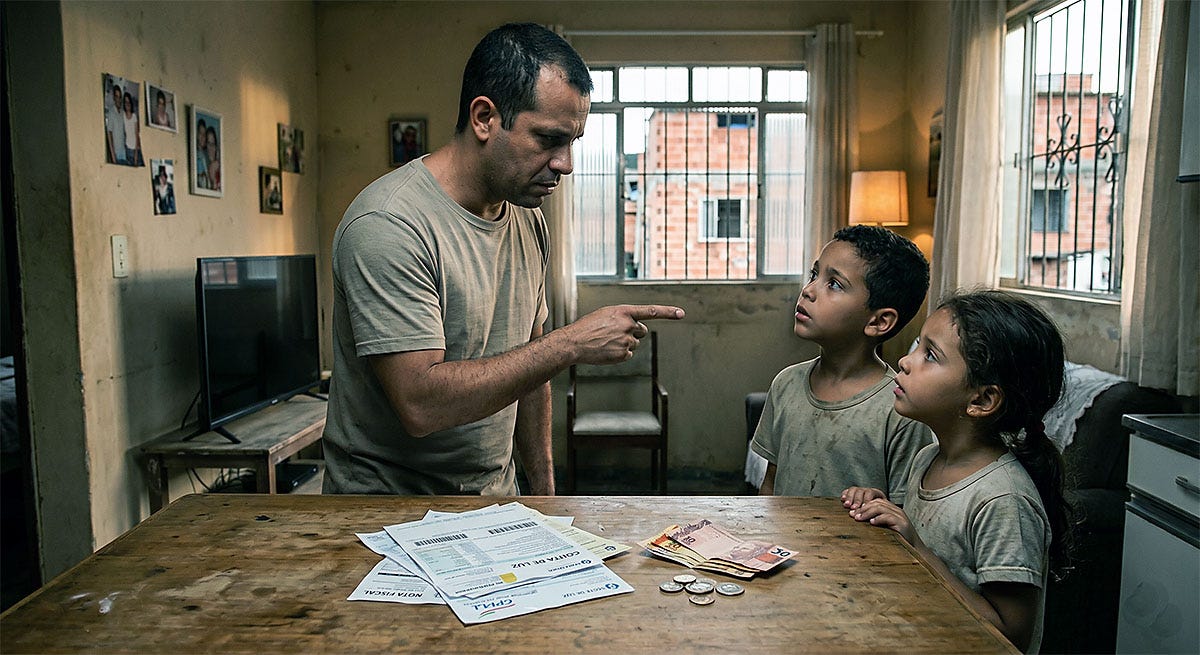
As mentioned before, polling is almost a national sport in Brazil. It sometimes seems as if the country lives on predictions, as if everyone is constantly looking into a crystal ball to understand what will happen tomorrow. Especially in politics, polls follow one another in rapid succession. But outside of that world, things are less simple. There, people collide with something that no poll can make look better: their own financial reality.
The government now knows very well that the dissatisfaction of many Brazilians does not appear out of thin air. People say that everything is too expensive, that taxes keep rising, and that they have to go into debt just to survive. And yes, there is truth in that. But at the same time, no government can manage the financial life of every citizen. Just as a family cannot spend more than what comes in, the same applies to a country. Even governments do not always succeed in this. Sometimes everyone — citizens and government alike — needs to look in the mirror.
What the most recent poll shows
Datafolha questioned over two thousand people about their financial situation. The result is hardly surprising, but it is harsh: two out of three Brazilians have debts, and one in five is already behind on payments. Those who borrow from friends or family are particularly in trouble: 41% of them cannot pay that money back. It is no different with credit cards: nearly three out of ten people with credit card debt say they can no longer keep up with the installments.
On top of that, 27% of those surveyed use revolving credit — the most expensive form of borrowing, with interest rates that can rise to nearly 100% per year. And then there are the bills for water, electricity, internet, taxes… 28% of Brazilians are behind on those. At the checkout, you hear it every day: “Débito ou crédito?” I always answer “débito” because it helps me keep my spending under control. But most people choose “crédito,” as if to say: it doesn’t hurt now, we will see later. That small moment at the cash register sometimes says more about the country than an entire poll.
When you put everything together, a somber picture emerges: nearly a third of the country lives in a precarious financial situation. People are cutting back on outings, on food, on brands, on everything that is not strictly necessary. And yet the feeling remains that it is never enough.
And the gamblers?
The Central Bank study shows another side of the same problem. About 24 million Brazilians regularly bet money on online bets. These are often small amounts — an average of around R$ 100 per month — but on a national scale, that adds up to more than R$ 20 billion per month in bets. The typical gambler is young, usually between 20 and 30 years old, and often with a limited income. This is exactly the same group that indicates in the Datafolha poll that they have trouble paying bills.
This does not mean that gambling is the cause of the debt crisis. But it does show how vulnerable many people are. Anyone who already struggles to make ends meet has little margin. A few small bets per week can then be enough to disrupt the balance.
Then there are the Caixa lotteries, which are still much larger than online bets. They bring in about R$ 20.8 billion monthly. That is not just entertainment; it is a national habit, almost a ritual. But here too, small amounts add up, especially when millions of people participate.
Where it really begins according to many: education
After more than twenty-five years in Brazil, I see — along with many others — a cause that lies deeper than inflation, interest rates, or political policy: the lack of financial education. Not as a reproach, but as an observation. Many Brazilians never learn how money works, how interest piles up, how debt grows, how to make a budget, or how to assess risks. And what you do not learn as a child, you often have to discover the hard way as an adult.
That is why many people advocate for something simple but powerful: financial education in schools, from primary school through high school. Not as dry theory, but as practical knowledge: how to read a bill, how to save, how to avoid debt, and how to handle an unexpected expense. Those kinds of lessons stick, sometimes for a lifetime.
The example from above
In addition, citizens expect a government to show what it asks of its population: responsible financial management. No hollow statements on television, but clear explanations, in simple language, about why certain choices are made. A government that explains why it is cutting costs, why it sets priorities, and why it sometimes has to say no. A government that behaves like a father of a household who does not spend more than what comes in.
This is not a political preference, but a principle that applies in every household — and one that many people would like to see reflected in their leaders.
A country trying to understand itself
The Datafolha poll and the Central Bank study actually tell the same story. Brazilians are living in a financially difficult time. They try to find solutions, sometimes wise, sometimes desperate. They save, they borrow, they gamble, they hope. And meanwhile, almost half of the country remains convinced that the economic situation is bad.
Perhaps that is the real message of all those polls: not that people want to predict what is coming, but that they are trying to understand where they stand. And that, despite everything, they continue to look for ways to move forward — with better information, better choices, and perhaps, one day, better financial education.
Illustration AI generated
Stay updated. Click below to subscribe — free of charge.