

The news about Deolane Bezerra hit Brazil like a shockwave. It was the top story on television, shared endlessly across social media, and even people who had never followed her suddenly knew she had been detained. Folha de S.Paulo explained the situation: a police operation, allegations of money laundering, investigations into financial flows possibly linked to criminal activity. No one needs to declare her guilty — that is for the courts. But the fact that an influencer dominates national headlines says a great deal about the country we live in.
Who is Deolane, really? She is 38, began her career as a lawyer, and skillfully used her image to build an enormous following. She appeared in reality shows, cultivated a massive online presence, and became one of the most recognizable faces of Brazil’s influencer culture. Glamorous photos, luxury trips, expensive cars — a life that looked as if it had stepped straight out of a telenovela. And millions of João’s and Maria’s followed her as if she were part of their family. That is the power of social media: it creates an illusion of closeness, even when the real distance is enormous.
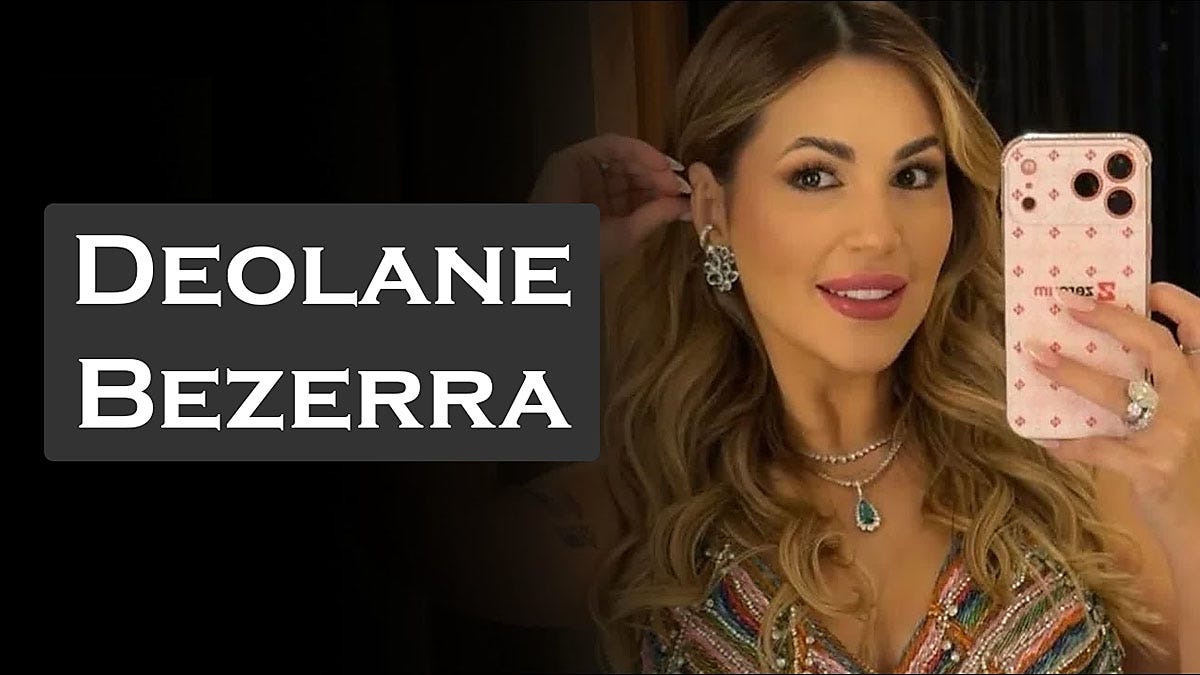
The numbers behind her success are staggering. Her engagement rate is estimated between 3.5% and 6%. With more than 21 million followers, that means hundreds of thousands of interactions per post. And that translates directly into money. She charges around $20,000* for three short Instagram Stories. Larger campaigns can reach $80,000. Her monthly income from advertising is estimated between $200,000 and $400,000. Her reach is literally worth millions.
And then there is Virginia Fonseca, 27 — perhaps the biggest of them all. A young woman who turned her life into an open book. Every pregnancy, every argument, every laugh, every tear was shared. She became famous because she understood that people were not looking for content, but for a feeling of connection. She didn’t need to say anything meaningful. She only needed to exist, day after day, and the audience followed. Even in the most remote corners of Brazil, people know her name. Ask them who Jorge Messias is, or what his rejection by the Senate meant for Lula, and you will get a blank stare. But ask about Virginia, and everyone knows exactly who you mean.
Her numbers are even more extreme. More than 55 million Instagram followers. An engagement rate between 3% and 5%, which means 1.5 to 2 million likes per post. For a commercial package she charges at least $60,000, often with a percentage of sales added. Major campaigns easily reach $100,000. During one livestream she sold $4.4 million in just 13 hours. Her digital empire generated around $260 million last year. Her likes are worth hundreds of millions.
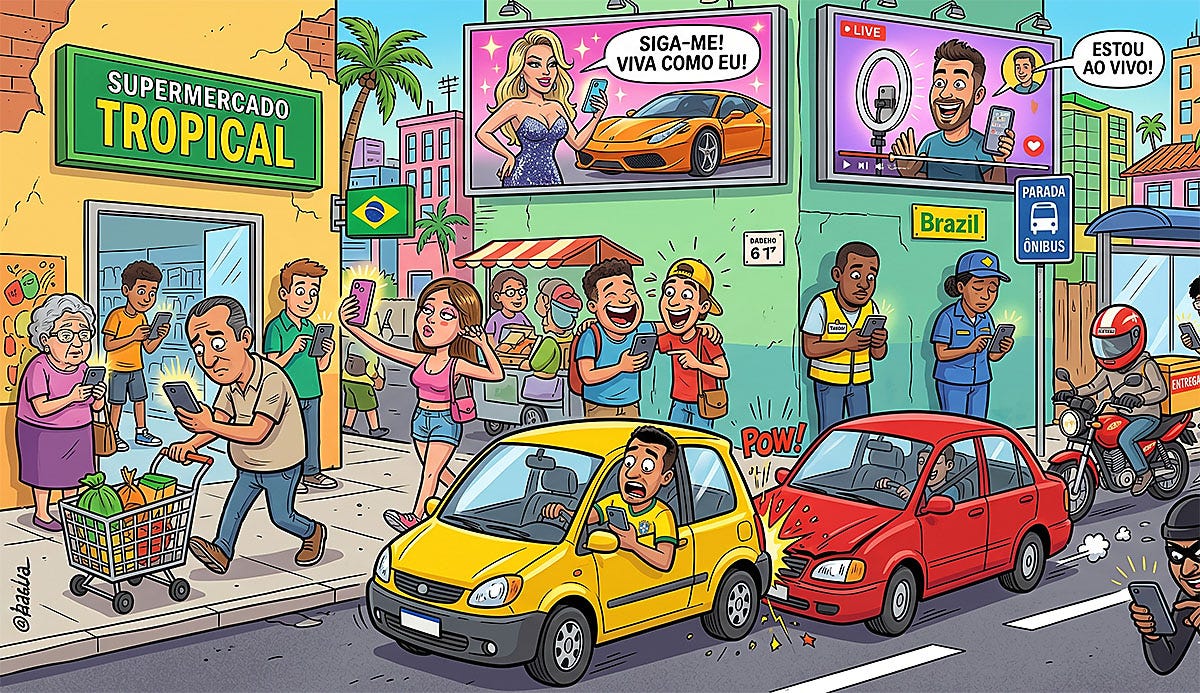
This is the country we live in: a nation with more registered smartphones than inhabitants. A place where people often have two phones — one for banking at home, one for everything else. A country where the digital world has penetrated so deeply that real life sometimes gets pushed aside. I see it every day. People who suddenly stop in the middle of the supermarket aisle, leaning on their cart, blocking the way, completely absorbed by their screen. Employees disappearing into a corner as if the world has paused. A housemaid interrupting her work again and again because another message or audio has arrived. It is an addiction no one finds strange anymore.
But there is another category of influencers, perhaps even more dangerous: the political influencers. Felipe Neto is the most famous example. He began as an entertainer, making videos for young audiences, gathering millions of followers through humor and games. But at some point he decided to enter politics. He chose a side, became one of the loudest voices in Brazil’s polarization, and transformed from entertainer into political actor. That is his right, of course. Everyone may have an opinion. But when someone with millions of followers enters the political arena, the dynamic changes completely. An opinion becomes a weapon. An influencer becomes an instrument. And it is not unthinkable that political interests try to benefit from that enormous visibility. Who will ever know?
Thiago Reis and André Janones went even further. They turned politics into their entire digital identity. Their videos were no longer opinions but battle cries. Thiago Reis began his posts with “Atomic Bomb!” or “Urgent,” hoping his followers would click instantly. Janones used his platform to organize political mobilization as if the election campaign never ended. And on the other side of the political spectrum, the same thing happened. The line is blurry: when is someone just an influencer earning money from likes, and when do they become a political agitator stirring up the population? And what if both happen at the same time? What if polarization itself becomes a business model?
Perhaps the most disturbing part is this: social media algorithms reward conflict. The more anger, the more views. The more drama, the more engagement. The more engagement, the more money. And so influencers — whether they want to or not — are pulled into a system that enriches them as long as they keep feeding the flames of division.
Influencers exist everywhere, of course. In the United States you have the Paul brothers, in Europe the lifestyle gurus, in Asia the livestream queens who sell millions per hour. But nowhere has digital culture penetrated as deeply as in Brazil. Nowhere is the smartphone such an extension of the body. Nowhere is the line between entertainment, commerce and politics so thin. Nowhere do influencers become national icons so quickly. And nowhere are people so vulnerable to the illusion that someone else’s life matters more than their own.
That is why I no longer call them influencers, but something else entirely — not a label, but a reality: people who sell illusions. They offer glitter, filters, drama, outrage, and curated fantasies. But when you strip all that away, what remains? Nothing. Only emptiness.
And yet they shape the behavior of millions. They influence what people buy, what they think, who they admire, who they hate, and even how they vote. That is not a small detail. It is a shift in the power structure of a country.
The worst part is that this is only the beginning. With AI, these illusion-sellers can produce content faster, create even more fantasies, and spread misinformation at unprecedented speed. They don’t even need to be present anymore. A digital version of themselves can do the work — and their followers won’t notice the difference.
Meanwhile, real life slips by. People lose time, attention, concentration, money, and sometimes even their safety. They are swept away by a world that gives nothing back except distraction. And perhaps that is the greatest deception of all: not that influencers lie, but that they make us forget what truly matters.
Those who let themselves be guided by these illusions lose not only time, but also sight of what truly counts — their own life, slipping by faster than any video.
*(Amounts originally in Brazilian reais, converted to USD for clarity.)