

In an earlier piece on the voting intentions of Brazilians, I referred to the four generations that, according to recent analyses, shape the country’s political landscape: Bossa Nova, Ordem e Progresso, Redemocratização and Geração.com. The latter, representing roughly twelve percent of the population, deserves particular attention. These are young people born between 2000 and 2009, just old enough to vote and simultaneously the first generation to have grown up entirely in a digital world. Yet it is striking that this group, although demographically small, becomes much larger when we look at the number of people who can truly be considered digital natives. Several terms are used for this category: early adopters, digitally skilled users, and sometimes even the “digital elite” — a group that not only has access to the latest technology but also possesses the intellectual tools to understand and navigate complex digital systems.
When we examine the most recent data from 2025 and early 2026, the level of internet penetration in Brazil is remarkable. Around 88% of the population — between 163 and 185 million people — uses the internet. Mobile phone ownership is nearly universal at 97%. But these numbers conceal an important nuance: access to technology does not mean understanding it, let alone using it safely and efficiently. The digital elite is concentrated mainly in the upper class, where almost everyone has access to multiple devices — both computers and smartphones — and can therefore perform complex digital tasks, from banking to tax filings to professional software use. In the lower social classes D and E, the situation is different. There, 87% of people access the internet exclusively through their mobile phones, which severely limits the possibilities for more advanced digital use.
Regionally, the Southeast and Center-West continue to lead in connectivity, but the fastest growth in recent years has occurred in the North and Northeast. The digital divide is narrowing, but it remains tangible. Only part of the population has what researchers call “meaningful connectivity”: a combination of speed, stability and adequate equipment that allows full use of digital resources. For millions of Brazilians, that threshold remains high.
This divide has far-reaching consequences, especially for the Bossa Nova generation. According to IBGE, Brazil has more than fifteen million people over the age of seventy. A significant portion of them lacks meaningful connectivity, and the consequences are dramatic. Among older adults who do not use the internet, 66% say they simply do not know how. It is not unwillingness but inability — a generation that did not live through the digital revolution and now faces a society that is digitizing faster than they can keep up with.
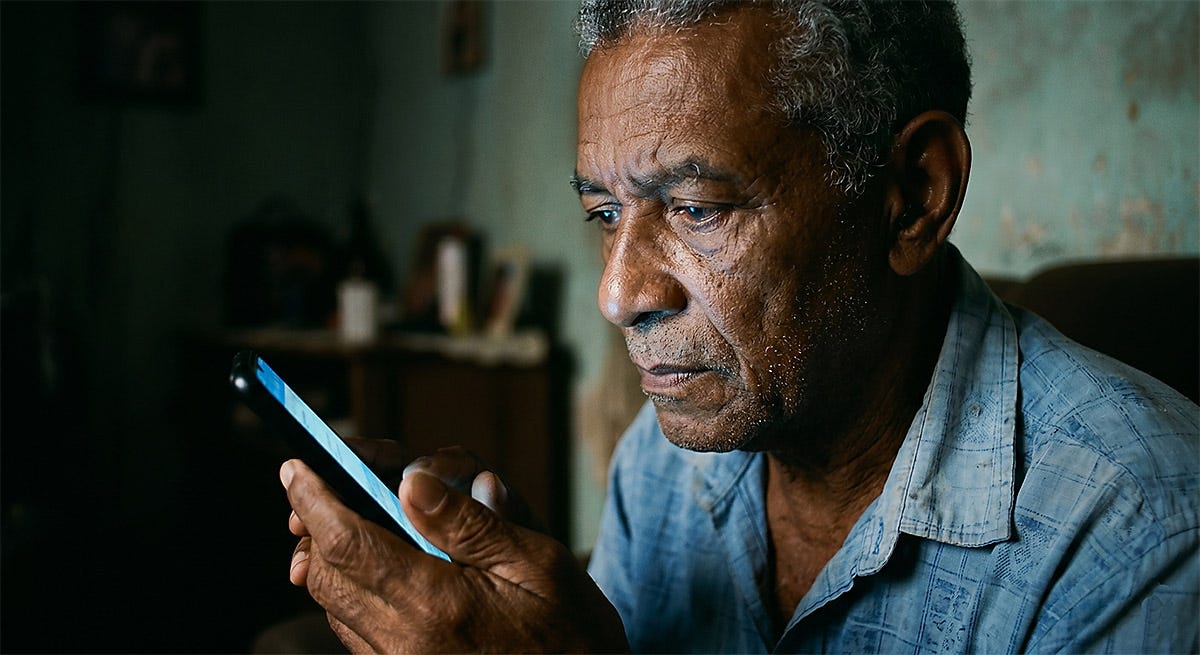
On top of this comes the issue of illiteracy. In 2024, around 14.9% of Brazilians over sixty were illiterate — more than five million people. In the Northeast, these percentages are even higher. For those who can read but do not understand “digital codes,” the barriers are just as high. Computer use among older adults has dropped sharply in recent years, from 63% to just 33%, replaced by the smartphone. But a smartphone is not a suitable instrument for complex tasks. The screen is small, the interface is unstable, and security is difficult to manage. As a result, many older adults own a device but use it only for basic functions: calling, receiving messages, viewing photos and — above all — endlessly scrolling through social media.
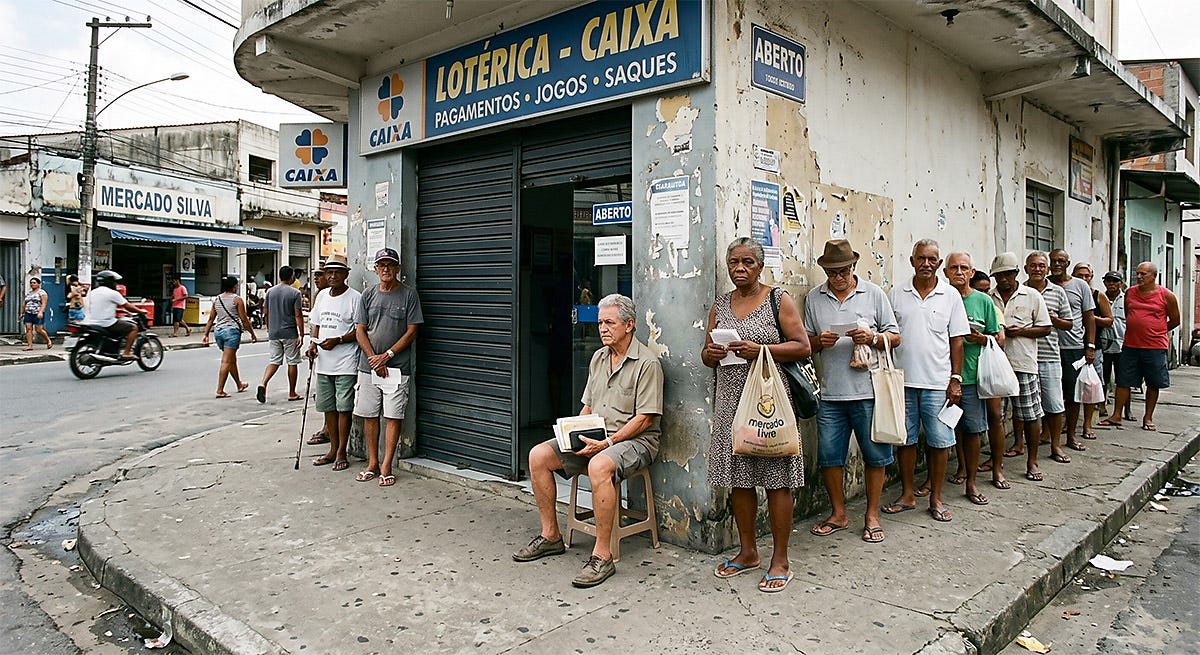
There is another aspect that is often overlooked: the persistent habit of many older adults to withdraw their entire monthly income in cash at a Casa Lotérica or bank branch. It is not uncommon to see them standing in long lines, sometimes under the scorching sun, to withdraw money they will later store at home. Some are even afraid to use ATMs, worried about making mistakes, being scammed, or simply because they do not understand how the machine works. The time lost is enormous, but for them it is the only way to feel in control of their own money. Meanwhile, banks are closing branches at a rapid pace, especially in rural areas. Towns that once had a branch now depend on neighboring cities, often far away, where internet connectivity is unreliable. People are being forced to digitize, but not everyone succeeds. For older adults with limited mobility, a simple banking task becomes half a day’s journey. Society is changing faster than they can follow, and the consequences are sometimes harsh.
I see this regularly among friends and acquaintances. People who are well educated, who have had respectable careers, and yet are completely dependent on others when it comes to digital security. That alone is worrying, but it becomes dangerous when we realize that this vulnerability is fertile ground for crime. More than 80% of older adults in urban areas such as São Paulo report having been targeted by digital scam attempts. The most common successful frauds involve unauthorized loans and identity theft through banking apps. Around 68% of Brazilian seniors believe it is nearly impossible to fully protect themselves from online fraud. That sense of helplessness may be even more alarming than the fraud itself.
A simple everyday example illustrates this clearly. A man in his seventies hires a handyman who charges R$ 150, a relatively low amount. The arrangement is that the service provider will come to his home to collect the payment, at the older client’s request. On the agreed day, the handyman is delayed and only arrives hours later. The client, a punctual man, spends the entire day at home waiting to hand over the money in person. He does own a smartphone, but he does not know how to make a Pix transfer. Moreover, he does not trust the system. When the man finally arrives, the client hands him a R$ 200 bill. “Sorry, I don’t have change,” is the reply. And there you are. Two full days wasted on something that could have been resolved in seconds.
Another acquaintance contacted me after receiving a WhatsApp message supposedly from the Receita Federal. According to the message, his CPF was about to be suspended because he was behind on a payment. The man was literally trembling with fear. Having your CPF invalidated is a serious matter in Brazil. I immediately sensed something was wrong, asked a few questions, and it quickly became clear that it was a scam. I managed to reassure him, but it could easily have ended differently. And such messages are countless: fake investment pages promising easy wealth, fabricated news claiming pensions will be blocked, warnings about imaginary government measures. Because many older adults forward everything they receive to their entire contact list, this nonsense spreads like wildfire. Fear triumphs over caution, emotion over reason, reflex over reflection.
The elections are approaching. In October, Brazil will choose a new president and new state governors. Officially, campaigns begin in August, but in reality the digital battle has long been underway. Social media is flooded with comments, videos, cartoons and “news” that is often entirely fabricated. Artificial intelligence does the rest. It is no exaggeration to say that many people are misled — especially the young and the elderly. The speed at which such messages spread is astonishing, and I am repeatedly struck by the credibility they are given. It is no wonder that political polarization in Brazil is so persistent.
All of this forms a massive problem in Brazilian society, one that can only be addressed through better education and digital literacy. For the Bossa Nova generation, time will eventually soften the gap. But no one knows what the future holds for the .com generation. They are digitally skilled, yet they live in a world where the line between real and fake grows ever thinner. The question is not whether they will master technology, but whether they will be able to see through it.
This is why I believe there is a clear responsibility for the government, both toward the Bossa Nova generation and many who came after them. Not as a luxury, but as a social duty. Digital education is no longer optional — it has become a basic need in a society that changes at high speed. Just as health posts and emergency units exist for medical care, there should be physical spaces where people can seek digital guidance. Many would welcome such help with open arms, without shame, if only they were told that ignorance is not a personal failure but a consequence of unequal opportunities. Digitalization cannot be reversed, but excluding people because they cannot keep up is unjust. Campaigns, pamphlets, television programs, local initiatives — anything that helps narrow the gap — should already exist. Banks will not solve this; they are closing branches and abandoning precisely the customers who need the most support. Those who can solve it must not only say so, but act. For me, this is not a political preference but a simple call for responsibility: a society that protects its elderly protects itself.
The images accompanying this article were generated by artificial intelligence. They do not depict real people and serve only to visually support the content of this text. Keep in mind that many images circulating on social media are also not real — with the difference that you are rarely warned about it there. Always look with a critical eye.