

It’s no exaggeration to say that bolsonarismo is a phenomenon with peculiar characteristics. The story of the man who gave his name to the movement — a story that today even leads some of his followers to drink a dishwashing liquid withdrawn from the market by an institute of the current left-wing government — is one I’ve told here before. So it’s hardly surprising that a film is now being made that tells that same story, even though its main character is under house arrest after being sentenced to 27 years in prison for his alleged role in the attempted coup of January 8, 2023. The title of the film: Dark Horse.
Films about Brazilian politicians
A few years ago, two films about Lula were released, and they form a useful backdrop for understanding why a project like Dark Horse immediately raises questions. In 2009, Lula, o Filho do Brasil appeared, a narrative feature film that romanticized Lula’s childhood and his rise as a union leader. The film came out while Lula was still president, which led many Brazilians to feel that the project was meant to burnish his image at a politically strategic moment. The timing and the financing were viewed with suspicion, precisely because it’s unusual for a sitting leader to be portrayed on such a grand scale.
Later came Lula, Oliver Stone’s documentary. That film was made while Lula was still in the middle of legal and political battles, and even during his return to power. Stone had exceptional access and followed him from his arrest to his re-election. That too raised questions: how independent can a documentary be when its subject is still an active politician, and when the filmmaker is so close to him? For many viewers, it felt less like a documentary and more like an attempt to shape an image.
Together, these two projects show that films about living, active politicians in Brazil are always sensitive. They quickly give the impression of self-glorification, political influence, or strategic image-building, and they almost automatically raise questions about who is financing them and why. With that history in mind, it’s easy to understand why Dark Horse entered a charged atmosphere from the very beginning.
The film in the making
Dark Horse is a film that tries to show how Jair Bolsonaro, once a fringe figure in Brazilian politics, managed to become a president who made headlines around the world. For many non-Brazilians, Bolsonaro is mainly a name that appeared in stories about Amazon fires, clashes with journalists, fights with judges, and his striking approach to the pandemic. But the film wants to show that his rise didn’t come out of nowhere. It tries to reconstruct how a man who was barely taken seriously in Brasília suddenly became the symbol of an angry, divided, and deeply disillusioned society.
A large part of the film focuses on the years before his presidency, when Bolsonaro was known mainly as a military man nostalgic for the dictatorship and as a politician who stood out for provocative statements. In Brazil, he was long seen as a political outsider who would never gain real power. But that outsider image later became his greatest asset. The film shows how he managed to present himself as someone “fighting the system” at a time when millions of Brazilians had completely lost faith in that system due to corruption scandals, economic crisis, and an increasingly toxic political climate.
What Dark Horse tries to make clear is that Bolsonaro’s rise is not just about him, but about a country shaken to its core in a short period of time. His style — direct, aggressive, anti-establishment — fit perfectly with an audience that felt betrayed by traditional parties. The film shows how social media played a crucial role: Bolsonaro had no major party machine, no classic campaign, but he did have an army of online supporters who spread his message at lightning speed. For viewers outside Brazil, this helps explain why he developed such a strong bond with his base, despite all the controversies surrounding him.
Another important element in the film is the way Bolsonaro wove his family into his political project. His sons became not only campaigners but strategists, spokesmen, and sometimes even ideological guides. For those unfamiliar with the Brazilian context, that may seem strange, but Dark Horse shows how the “Bolsonaro clan” functioned as a kind of mini-movement within the movement, with each family member playing a role in strengthening the Bolsonaro brand.
The film is therefore not a neutral documentary, but an attempt to tell a story: how a man who spent years on the sidelines suddenly became the center of power. And how that could happen in a country that has struggled for decades with inequality, corruption, and political instability. For non-Brazilians, that may be the most important insight: Bolsonaro was not just an incident, but the product of a much larger crisis that Brazil still hasn’t fully processed.
The explosion
And then came the real explosion — not on screen, but in Brazilian politics itself. While Dark Horse was still unfinished, news broke that Flávio Bolsonaro, senator and presidential candidate, had helped finance the film through a businessman now at the center of a financial scandal: Daniel Vorcaro, the man linked to the troubles at Banco Master. To outsiders, this may sound like “yet another Brazilian scandal,” but in Brazil the news hit like a bomb. Not only because it involves money and politics, but because it touches on something extremely sensitive for Brazilians: the question of who pays behind the scenes to shape the image of a politician.
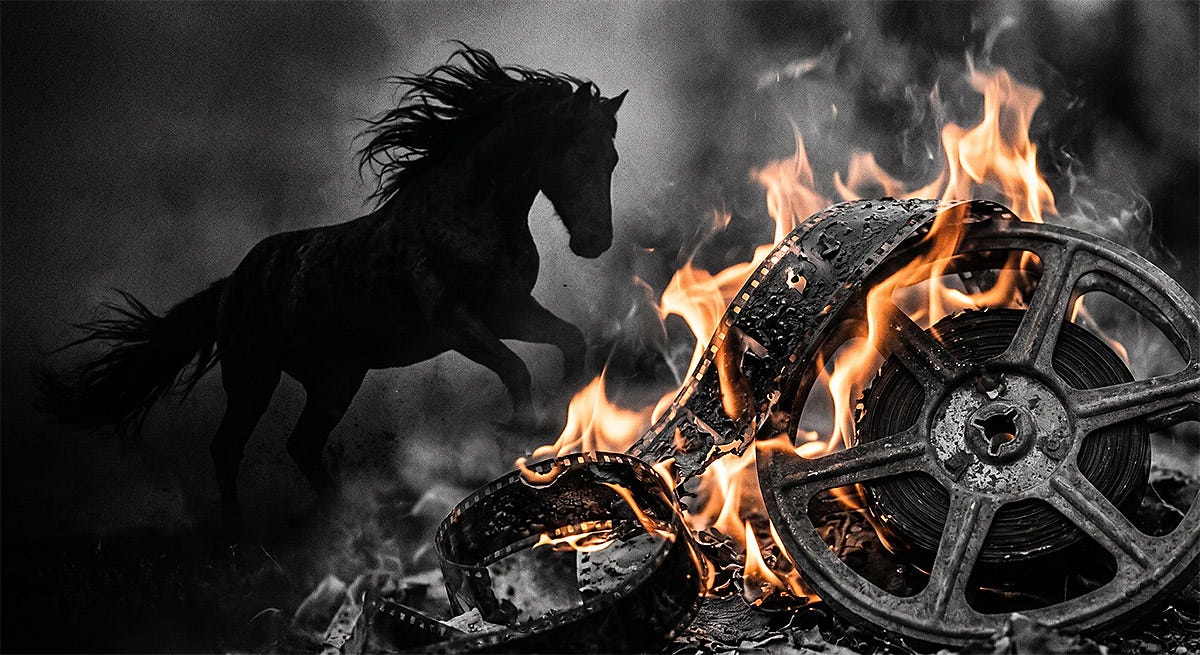
Until that moment, Dark Horse had been seen mainly as an ambitious film project telling Bolsonaro’s story. But once it became clear that Flávio Bolsonaro was involved in the financing, the tone changed completely. The film itself seemed to catch fire — hence the image of the burning film reel and the raging horse — because everyone began to wonder what the real purpose was. Was it art, history, or an attempt to polish the Bolsonaro family’s image at a crucial political moment? And above all: what does this say about the broader Bolsonaro brand, which likes to present itself as a victim of the system, yet once again finds itself entangled in questions about money and power?
Polls
Polls from recent months already showed that Brazil is in an exceptionally tense phase. Lula remained the best-known and most experienced figure in the field, but his popularity was under pressure due to economic dissatisfaction, rising prices, and a growing sense of fatigue among parts of the population. Flávio Bolsonaro, who positioned himself as the heir to the Bolsonaro project, gained little from this. His numbers remained flat, sometimes even declining, and he failed to turn the enthusiasm of the hardcore Bolsonaro base into broader support.
Just before the news about the financing of Dark Horse broke, Flávio was already in a vulnerable position: visible, loud in the media, but without any real breakthrough in the polls. Analysts described it as a kind of political standstill. Lula wasn’t winning, Flávio wasn’t winning, and voters seemed to be waiting for something that would shake up the landscape.
That “something” came sooner than expected. The revelation that Flávio Bolsonaro was involved in financing the film — through Daniel Vorcaro, a businessman linked to the Banco Master scandal — instantly changed the dynamic. In a country where memories of corruption scandals are still fresh, and where the question “who pays for what?” always carries political weight, the news resonated immediately. Not because it’s about a film, but because it touches on trust, transparency, and the integrity of a candidate presenting himself as an alternative to the current government.
What this means for upcoming polls remains to be seen — that depends on how voters react, how the media continues to cover the story, and how Flávio defends himself. But it’s clear that this scandal changes the atmosphere around his campaign. Polls in Brazil often react quickly to new information, especially when it involves money, power, and potential influence. The next measurements will show how much damage has been done, whether shifts occur, and whether this story continues to reverberate.
What is certain is that Dark Horse is now far more than a film project. It has become a political flashpoint, one that affects not only the Bolsonaro family but also the broader sense of distrust that has haunted Brazilian politics for years. And that is why everyone is now watching the upcoming polls — not to predict a winner, but to see how deep this blow really goes.