

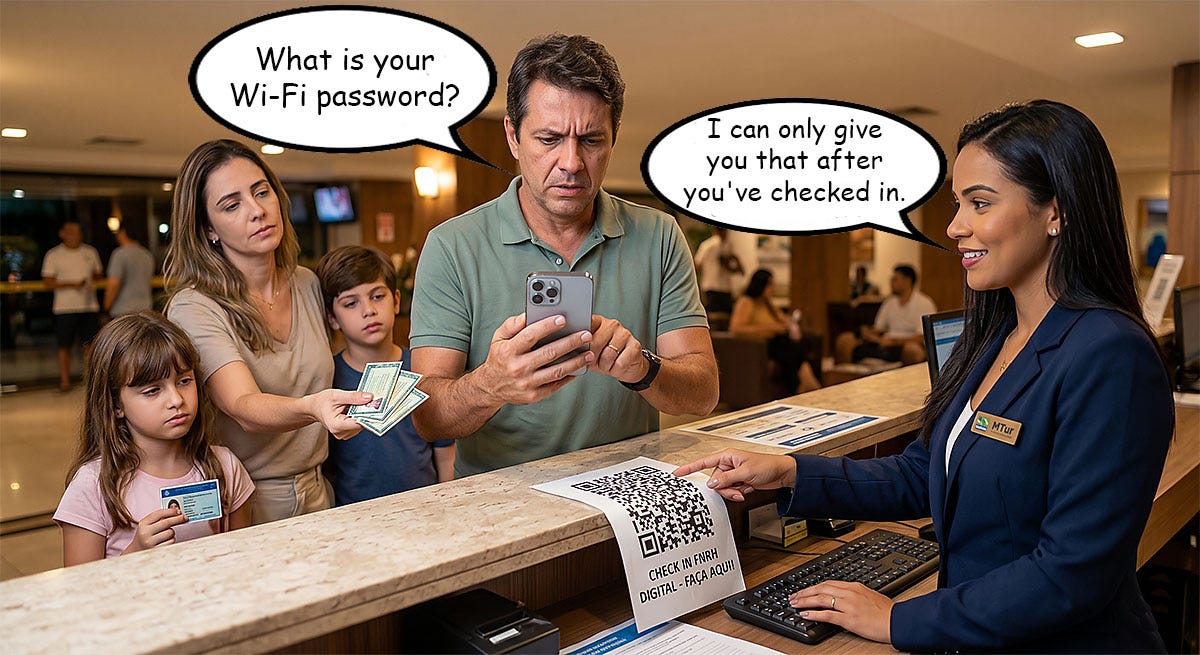
In a previous contribution about the Brazilian authorities’ mania for providing almost everything concerning them with abbreviations—which have since formed a labyrinth in which a cat could no longer find her own kittens—I wrote: “In Brazil, an acronym is not just an abbreviation; it is a way of life. It is the language of a bureaucracy so vast that it no longer fits its own words.” Now, another one has arrived: FNRH Digital. Even if it isn’t immediately clear what it’s about, you can quickly guess: they’ve found something new to keep an eye on João Average. Indeed, they have.
FNRH already existed and stands for “Ficha Nacional de Registro de Hóspedes” (roughly translated: National Guest Registration Form). The addition of “Digital” replaces the ballpoint pen at the reception of a hotel or pousada with—yet again—a smartphone. In the corridors and communications of the Ministry of Tourism (MTur), however, the system is often simply touted as “Check-in Digital.” The FNRH Digital is not just a form; it is part of a larger digital ecosystem developed by Serpro (the federal government’s giant IT service). And is that it? No, Brazil wouldn’t be Brazil if there weren’t side effects involved. Let’s clarify:
Cadastur is the database in which all hotels and pousadas must be registered. The FNRH Digital is directly linked to this. If a hotel is not in Cadastur, it is officially operating illegally.
Módulo Hóspede is the specific portal where the guest must enter their data. For “companions” (spouse, children...), the system uses the term Dependentes. You must literally link them as ‘dependents’ to your profile to complete the process.
Pre-check-in is the marketing term the government uses. It sounds like a favor (save time at the reception!), but in reality, it is the way the citizen takes over the civil servant’s work by pumping their own data into the state database in advance.
The new regulation officially came into force on April 20, 2026, but initial reports state that, so far, less than 25% of smaller pousadas actually have the system operational.
Big Brother’s Newest Weapon
The Brazilian government presents the new, mandatory digital check-in procedure in hotels and pousadas as a great step forward. The old-fashioned paper forms from the Ministry of Tourism are making way for a digital system that should, in theory, be handled within two minutes. But anyone who looks slightly beyond the shiny interface of this modernization sees a very different reality. It is the next step in a process of total control that we previously saw with the central role of the CPF. Where the government speaks of convenience for the tourist, the last space for anonymity and informal freedom is, in fact, being boarded up.
The Practice
The practical implementation immediately shows that the term “simplification” is out of place here. For a family with two children, this means that it is no longer just the head of the family who identifies themselves, but every individual, including minors, must be fully included in the system. Anyone who has ever tried this on a small smartphone with a flickering internet connection somewhere in a remote pousada knows that this is anything but smooth. It is a cumbersome process that increases rather than decreases frustration at the counter. Furthermore, the hotelier can no longer fudge the numbers or “forget” to register a guest to evade taxes. The digital line to the government’s central servers is direct and merciless.
Salacious Details
However, we find the most salacious aspect of this new regulation in the world of motels. Brazil has an extensive culture of motels where discretion is the ultimate good. With the arrival of digital registration, which can often be linked to the central Gov.br account, that discretion is seriously threatened. The man who claims to be traveling for business while staying elsewhere will think twice from now on. Although hotel employees could occasionally turn a blind eye in the past, the system now records everything irrevocably. The government knows exactly who is spending the night, where, and with whom.
What we are seeing here is Big Brother at one of his peaks. The Brazilian state is crawling under the guest’s sheets and holding the pen used to register the children. Privacy is sacrificed on the altar of digital efficiency and the fight against tax evasion. It is a development that fundamentally changes Brazilian society. The days when you, as a traveler, could still stay somewhat under the radar are definitively over. Every step, every overnight stay, and every traveling companion now leaves a digital trail in the government archives.
How It Works
If you book in advance, the hotel (or pousada) sends a link or shows a QR code. Those who have a CPF can log in via Gov.br, after which all fields (name, address, documents) are filled in automatically. If it concerns an entire family, the hassle begins because the law demands individual registration for every guest. A father who arrives with his wife and two children after a long journey, and has not registered the check-in beforehand, must now fill in or check four digital forms on a small screen. In a country where 4G outside the big cities is often more “G” than “4,” this leads to faltering connections and queues that are longer than in the paper era. And what about non-Brazilians?
Temporary visitors, business people, and tourists without a CPF must enter their passport details manually into the hotel’s web app. The hotel is then obliged to sign this digitally, giving the Federal Police an immediate digital “flag” as to where every foreigner is located.
Tchau Jeitinho
The hotel sector used to be able to “fudge” things easily. Renting out a room off the books was simple: you tore up the paper form and the income officially didn’t exist. With the digital FNRH, the government sees the occupancy rate in real-time. If a hotel registers fifty digital check-ins but only declares twenty rooms to the tax authorities, a red flag appears immediately. Moreover, fines for not using the new system run up to R$ 10,000, and for repeat offenses, the permit (Cadastur) can be revoked.
AIRBNB
For now, this remains the largest gray area. Many Airbnb hosts are currently escaping the FNRH obligation because they are not legally seen as a “hotel business.” However, the government is working on regulations to force short-term rentals via platforms into data sharing. Airbnb in Brazil already increasingly asks for guests’ CPF during booking to comply with local tax rules. The step toward a full digital form for every Airbnb guest is only a matter of time.
It is a sophisticated system. The government sells it as “speed and convenience,” but it is a data machine. It links your CPF to your location, your travel party, and your spending patterns. The hotel clerk can indeed close their eyes, but the algorithms of the Receita Federal and the Federal Police do not. In the Brazilian context, where the line between privacy and government interference was always thin, this system is the ultimate tool for total surveillance under the guise of tourist modernization.
The Privacy Law (LGPD)
The “Lei Geral de Proteção de Dados Pessoais” is the Brazilian legislation that regulates the processing of personal data by companies and government agencies and protects the privacy and freedom rights of individuals. The law guarantees transparency, security, and control over the information collected (physical or digital), allowing users to see how their data is being used and to demand it be deleted or corrected. It is a modern law (2018), but in practice, it seems to apply primarily to companies and less to the state itself. The government demands that hotels protect guests’ data, while that same government centrally stores every movement of those same guests via Serpro. It is a paradox: your privacy is “protected” by giving your data directly to the country’s largest data collector.
Stay updated. Click below to subscribe — free of charge.