

Former Finance Minister Fernando Haddad — who stepped down in March to run for Governor of São Paulo — repeatedly criticized the “financial burden” the Lula government allegedly inherited in 2023 from his predecessor, Jair Bolsonaro, until his last day in office. According to him and the Workers’ Party (PT), this past explains the difficulty of reorganizing public finances throughout the term. It is true that there were excesses, compounded by emergency pandemic investments, repeated breaches of the spending cap, and a billion-dollar debt in precatórios (court-ordered government debts to citizens or companies) that were simply kicked down the road. However, these arguments do not absolve the current economic team of their responsibilities. Under the leadership of Haddad and his successor, Dario Durigan, the government has created a financial time bomb that is once again being passed on to the next generation.
The combination of rapidly growing spending, fiscal deficits, and high interest rates leads to a predictable outcome: exploding national debt. It is no coincidence that Brazil’s debt is growing at a pace comparable only to the most acute moments of crisis, such as the 2020 pandemic or the 2015-2016 recession. Projections from the Ministry of Finance itself confirm what was already known: debt will continue to rise through most of the next presidential term and will only begin to decrease slightly in 2030. This results in high interest rates, causing capital to flee toward safe government bonds instead of productive investments that could truly grow the country.
According to Central Bank data, Brazil’s national debt reached 79% of GDP last year. That percentage was only higher in 2020, at the peak of the pandemic, when it hit 87%. When Lula took the helm in January 2023, the indicator stood at 72%. We have to look far back, to the early 2000s, to see figures around 55%. The upward trend is far from over; debt is expected to grow further to 88% of GDP by 2029 — a figure that independent analysts, by the way, consider far too optimistic and hardly credible.
The International Monetary Fund (IMF) is even less optimistic in its latest forecasts, expecting Brazil’s debt to keep rising until at least 2031. Although the IMF uses a different methodology that yields higher figures — estimating debt at 93% for 2025 compared to the Central Bank’s 79% — the conclusion is painfully clear. Brazil is already among the most debt-ridden nations among emerging economies, and its position is likely to worsen. Currently, the country ranks 25th out of 183 economies tracked by the IMF, but by 2031, it is expected to climb to a debt equal to 103% of GDP. In comparison, Mexico and Colombia, countries somewhat similar to Brazil, see this indicator hovering around 60%.
The problem lies simply in government spending. If the current spending level is to be maintained without letting the debt explode, taxes — which are already substantial — must go up. But the country has reached the limit of its tax burden. Only a radical operation where the government “cuts into its own flesh” can restore balance. Lula, however, has no intention of doing so, should he be re-elected. For him, consumption is the sole engine for growth, supported by more credit for families to access higher-ticket products.
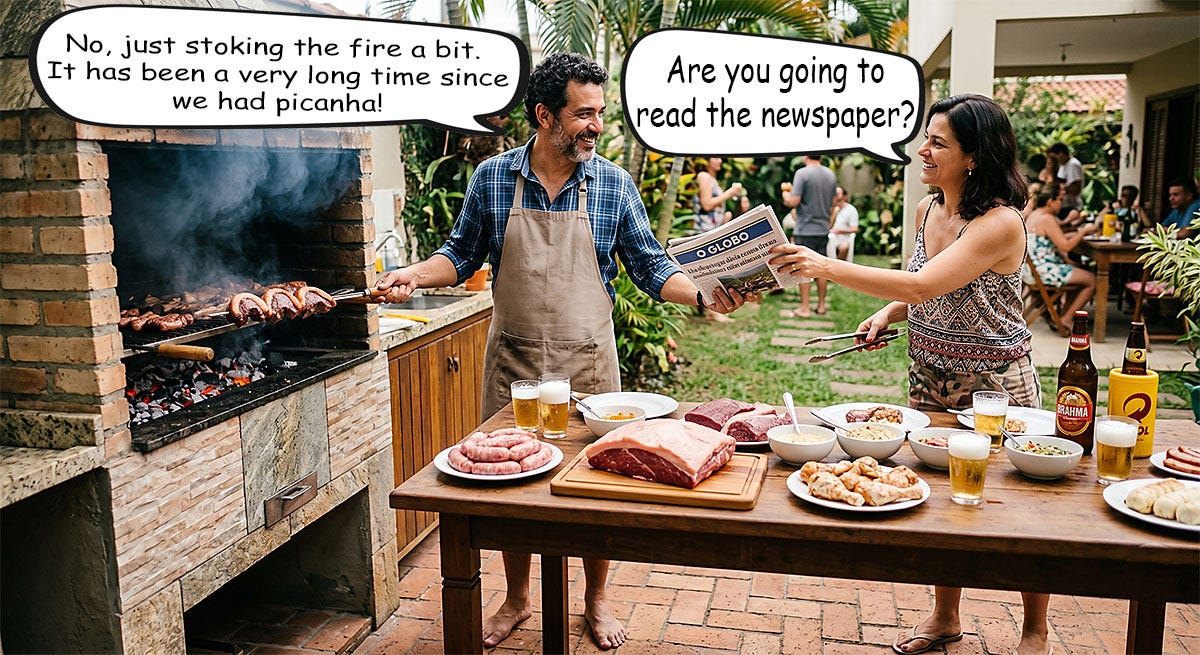
The President sees a clear role for the state in driving the economy through the purchasing power of the citizen. In his vision, the economy only truly functions when people have the means for basic needs like food and clothing, but also for computers and household appliances. Putting money into the hands of the people and small entrepreneurs, he believes, provides a direct boost to employment. To enable this, he advocates for expanded credit, seeing it not as a risk but as a necessary tool for families. He dreams of an internal market where Brazilians have the right to modern technology and decent cars, financed by loans deducted directly from their wages. It is a vision he has repeated since the early 2000s, but today it meets more skepticism than before. While iconic promises about the accessibility of consumer goods — such as his famous claim that every family should once again afford picanha and a beer — once offered hope, that rhetoric now clashes harshly with the reality of high inflation. For many Brazilians, the gap between the political promise and the price at the checkout has become so wide that these familiar stories are losing their luster; the memory of unfulfilled pledges means the population increasingly views his economic recipes as outdated.
The strategy of stimulating the economy through higher consumption means the focus remains on government investment and subsidies rather than austerity. For the President, social inclusion through consumption is more important than strict adherence to fiscal constraints. In doing so, he indicates that in a potential new term, he intends to stick to a model where the state actively drives consumption. This, however, clashes head-on with the sobering reality of the national debt. While he sells this as a social solution, economists point to structural risks. In this logic, an artificial stimulation of demand without fiscal reform inevitably leads to higher interest rates to curb inflation, which only makes servicing the debt more expensive.
The comparison with the past is far from reassuring. Critics warn that a next term threatens to be a repeat of the policies under Dilma Rousseff, but in an even more extreme form. While Lula once benefited from a favorable global wind and a commodity boom, that financial breathing room has virtually vanished. Holding onto this model of state intervention while debt creeps toward 100% of GDP is seen by many as ignoring a ticking time bomb. The government seems to be shifting toward an ideological hardening where state-owned companies must lead the way, which only pushes private investment toward the safety of government bonds.
All of this confirms that voters should pay more attention to what their candidate is going to do, and less to who they are. Decades of polarization will not reduce or settle the country’s debt — quite the contrary. The information in this argument is no fiction; it is drawn from recent analyses in Brazilian newspapers (Estadão, Folha) and magazines (Veja) that are available to (almost) everyone. However, the question remains whether the average citizen, who prefers their news in short snippets via Instagram or YouTube, still absorbs the gravity of these figures. A country cannot indefinitely spend what it does not have. If every Brazilian stood up today and demanded that the state behave like a responsible head of household — spending only after it has earned — policies would change tomorrow. As long as they settle for a short-term party on credit, the financial time bomb will continue to tick undisturbed.
Stay updated. Click below to subscribe — free of charge.