

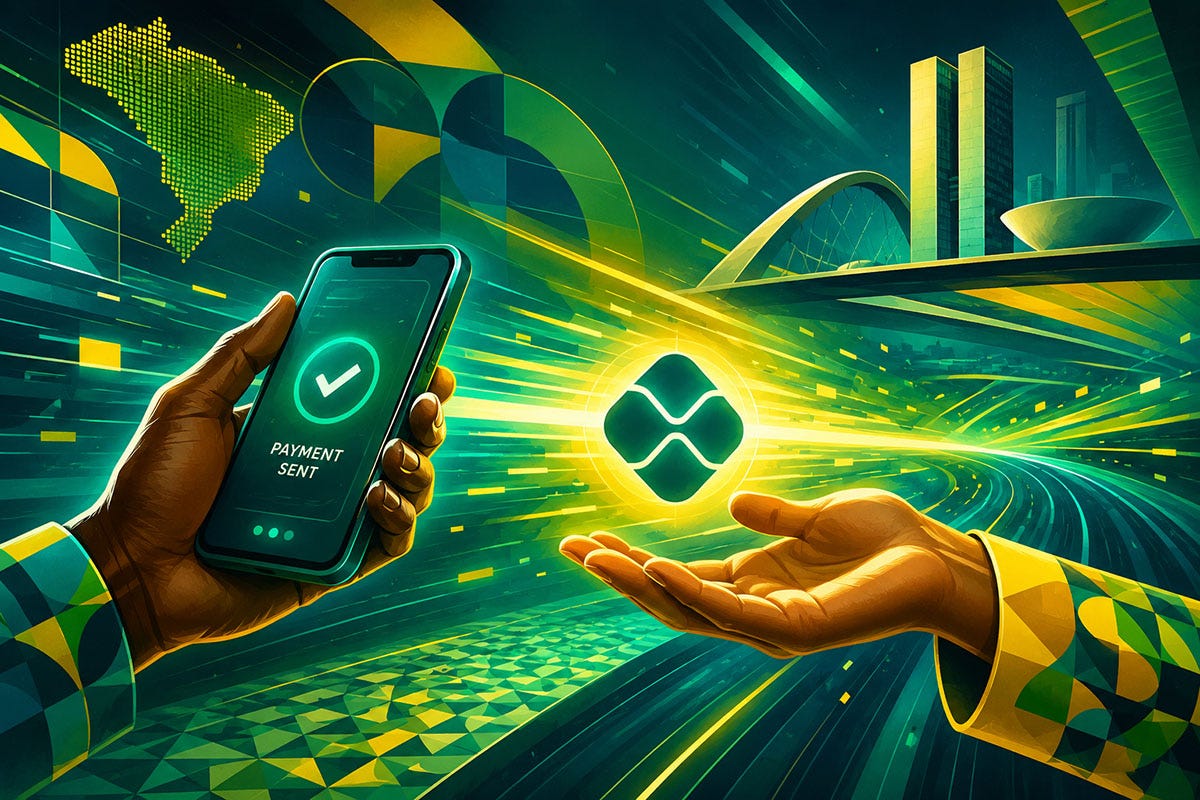
There are innovations you expect from countries with shiny subways, futuristic airports, and ministers who don’t trip over their own policies. Brazil is rarely on that list. And yet it is precisely there that one of the most modern payment systems in the world was invented: Pix.
Pix is not a gadget, not a fintech toy, not an experiment. It is a revolution that unfolded quietly. In 2020, the Central Bank launched a system so simple and efficient that it conquered the entire country within months. Today, Pix is so natural that you’re more likely to forget your shoes than your Pix key.
A QR code printed on a piece of cardboard is enough to receive a payment. Street vendors use it, dentists use it, universities use it, the guy selling coconuts on the beach in Salvador uses it. Pix is faster than any bank card, cheaper than any credit card, and more accessible than any fintech platform. It works anytime, anywhere, with no fees and no waiting.
The success was so overwhelming that other countries are now trying to copy it. Colombia is eager. Mexico is watching closely. Europe follows with mild jealousy. And in the United States, someone is raising an eyebrow: Donald Trump.
Why Pix suddenly appears in a U.S. report
BBC Brasil described how the Office of the United States Trade Representative (USTR) included Pix in an official report on “unfair trade practices.” That sounds serious, but the reasoning is surprisingly simple: Pix is so efficient and so cheap that it threatens the market position of American payment companies.
Visa, Mastercard, PayPal, Big Tech payment platforms — they watched millions of transactions shift toward a system that costs nothing and has no profit margin. For companies that live off transaction fees, that’s not a detail — it’s an existential threat.
The report goes even further: it accuses the Central Bank of forcing banks to offer Pix. In Washington, that sounds like “market distortion.” In Brazil, it sounds like “financial access for everyone.”
Pix achieved something almost unthinkable in the United States: it broke the power of the financial sector. In the U.S., the payment system is fragmented, expensive, and slow. A simple bank transfer can take days. Credit cards are king, but they survive on high fees ultimately paid by consumers.
Pix wiped that model out in Brazil.
And now there’s something new: Pix parcelado, an installment version of Pix. That is a direct attack on the credit card market — a market in Brazil long dominated by American companies. In other words: Pix is not just a payment method. It is a threat to a multibillion-dollar industry.
The human dimension of Pix
Pix didn’t just change the financial sector. It changed the lives of millions of Brazilians who never had a bank account, who depended on cash, who worked in the informal economy. For them, money was always physical: bills in a pocket, coins in a plastic bag — risks included. Cash meant vulnerability. A robbery could wipe out an entire month’s income.
Pix broke that pattern.
Suddenly, people who never stepped inside a bank could receive money through their phones. Street vendors who once depended on change could now accept payments without carrying a single real. Small entrepreneurs could compete with big chains because they finally had a modern, fast, free payment method. Even homeless people use Pix through social programs that help them create a digital identity. It is one of the few innovations that is both hyper-modern and socially transformative. Pix democratized money. And that may be the greatest revolution of all.
The political irony
Pix was created by a small team of technocrats inside the Central Bank, under a government not exactly known for technological vision. While the country was politically on fire, a group of economists, programmers, and policymakers quietly built a system that would turn the financial world upside down. The contrast is almost comical: a country that struggles to renovate an airport built a payment system that works better than what the U.S., Europe, and China offer. Pix is proof that bureaucracy can sometimes — very rarely — produce something brilliant, usually when no one is watching.
And then there’s China — the unexpected contrast
Here the story gets even more interesting. If there is one country that has amazed the world with technological leaps over the past twenty years, it’s China. There was a time when “Chinês Xing Ling” in Brazil was synonymous with cheap knockoffs — plastic toys that broke after two days, electronics that never worked as promised. A kind of folkloric disdain for everything from the East. But that changed. Fast.
China built high-speed trains, satellites, electric cars, drones, AI platforms, supercomputers. It became a technological empire that surpassed the U.S. in some areas. And yet — China doesn’t have Pix.
China has WeChat Pay and Alipay, yes. But those are private systems, run by giant companies, not by the state. They are powerful, but not universal. Not free. Not mandatory for every bank, every citizen, every merchant.
Pix is something else. Something unique — a system designed by the state, required to be offered by all banks, free for users, operating 24/7, moving money in seconds. Not even China has that, nor the U.S., nor Europe.
Pix is a rare example of a country in the Global South building a technological solution that works better than what major economic powers offer. And that deserves to be highlighted.
The geopolitical layer: BRICS and digital sovereignty
Pix fits into a broader global movement: countries want their own digital infrastructure, independent of American companies and Chinese platforms. BRICS nations are experimenting with alternative payment networks, digital currencies, and systems not dependent on Visa, Mastercard, or Silicon Valley. In that context, Pix is a strategic instrument. It shows that a country doesn’t need to wait for foreign technology to modernize. It can build something better itself.
For the U.S., that is an uncomfortable thought. Because whoever controls the payment infrastructure controls part of the economy. And whoever loses that, loses influence.
Pix is therefore not just a payment method. It is a symbol of digital sovereignty.
Is Trump truly concerned — or is this political theater?
The timing is no coincidence. The American payment industry is under pressure, and Trump has an interest in presenting himself as the man who protects American companies from foreign competition. Pix is an easy target: it is successful, it is Brazilian, and it costs American companies money.
But experts are clear: the U.S. cannot legally do anything against Pix. It is a domestic Brazilian system, managed by the Central Bank, entirely outside U.S. jurisdiction. What remains is political noise — a way to appear “vigilant” without any real consequence.
The future of Pix
Pix is only at the beginning. The Central Bank is working on:
Pix Internacional – cross-border payments without banks or credit card companies.
Pix Automático – automatic debits for subscriptions and recurring bills.
Pix Garantido – credit through Pix, an alternative to credit cards.
Pix for government services – taxes, fines, social programs.
If all this becomes reality, Pix could become an export product — a Brazilian technology adopted by other countries not because they want to imitate Latin America, but because it simply works better.