

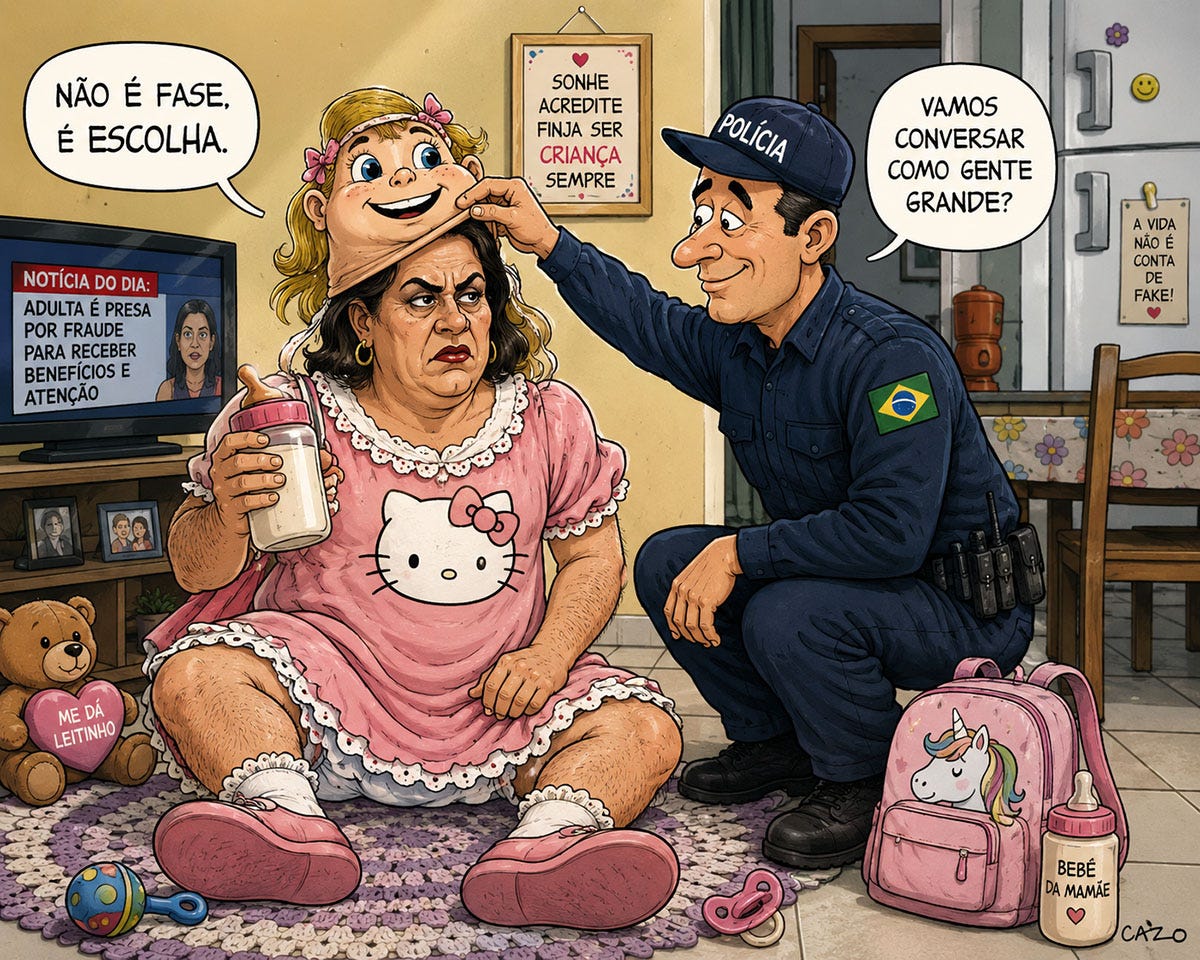
There are stories you read and immediately think: this could only happen in Brazil. Not because other countries lack bizarre situations, but because Brazil has a unique blend of empathy, improvisation, bureaucratic blind spots and a touch of telenovela drama that together form a national cocktail. And the story of Amanda — or Gabriele, or Maria Eduarda, or Beatriz, depending on the day — fits that cocktail perfectly.
In Joinville, in the south of the country, a 37-year-old woman lived for fourteen months as… a 12-year-old girl. That’s a sentence you read twice just to make sure you understood it correctly. But it wasn’t a costume joke, a prank or performance art. It was her daily reality. She drank from a mamadeira (baby bottle), walked around with a chupeta (pacifier), played with dolls and made children’s drawings. The family who took her in even decorated a full child’s bedroom for her, complete with toys and pastel colors. Not because they were naïve, but because they believed they were rescuing a vulnerable teenager who had fled abuse in northern Brazil.
They called her Gabriele, because that’s how she introduced herself. They even celebrated her twelfth birthday — cake, candles, the whole thing — the kind of party you only throw for children who still believe adults always tell the truth. The family had a big heart and a comfortable income, and that turned out to be a dangerous combination when faced with someone with an exceptional talent for manipulation.
According to the police, Amanda had a “high capacity for persuasion and empathy.” That sounds almost flattering, but it’s really a polite way of saying she delivered an acting performance that would make many soap stars jealous. Whenever someone questioned her adult features, she explained them away with autism and hormones she had supposedly been forced to take “as a child.” Everything was just believable enough, and just tragic enough, to stop people from asking too many questions.
But as in every Brazilian plot twist, the moment she arrived at the police station, the entire set collapsed. The “Gabriele” from Pará turned out to be Amanda from Ceará. And this wasn’t her first performance. Since 2018, she has played the same role in at least five states. In Rio de Janeiro she lived for a month as “Maria Eduarda,” cared for by two women who rented her a house and spent around R$ 2,000 on clothes, food and personal items for the “menina vulnerável” (vulnerable girl). In Minas Gerais she was taken in by a man who believed he was rescuing a thirteen-year-old. In São Paulo, Goiás, Florianópolis and Chapecó she repeated the same act, each time with a new name, as if she were a one-woman traveling theatre troupe performing a single script.
A very Brazilian crime: falsidade ideológica
In Brazil, this kind of deception falls under falsidade ideológica, literally “ideological falsehood.” The term sounds philosophical, but it’s simply criminal law: pretending to be someone you’re not, using false information, fabricated identities or misleading declarations. It can be as small as a forged signature or as elaborate as an entirely invented life. It’s a crime that appears frequently in Brazil, partly because the country’s vast bureaucracy doesn’t always communicate internally. Someone clever enough can slip through the cracks for surprisingly long.
A country wary of scams… yet still vulnerable
What makes this story even more striking is that Brazilians have been wary of scams for decades. In our earlier piece on fraud and digital deception, we described how deeply rooted that caution is. Everyone knows someone who has fallen victim to a golpe (scam), and the average Brazilian is often more alert than a bank’s fraud detection system. The country has developed an almost instinctive radar for suspicious calls, strange messages and too-good-to-be-true offers.
But that’s exactly why Amanda’s story worked so well. She didn’t prey on greed, but on empathy. Not on fear, but on compassion. She used no technology, no sophisticated scheme, no digital trickery. She used something far more powerful: human kindness. And even the most seasoned Brazilians fall for that, because no one wants to believe someone would go this far to exploit trust. It’s the perfect paradox: a country that sees through scammers, yet remains vulnerable to the most human form of deception.
The end of the performance
In Joinville, things eventually took a different turn. The family wanted to adopt her officially — and as Brazilians say: aí complica (that’s when things get complicated). The moment paperwork entered the picture, Amanda invented a new tragedy to avoid it. A violent father who might find her. A dangerous former guardian. A threat always just dramatic enough to freeze the conversation.
Until the police walked in.
There, in her child’s bedroom, surrounded by dolls and pacifiers, the mask fell. She confessed, gave her real name, her real age and her real origin. The family was left in shock — not only because they had been deceived, but because they had lived for fourteen months with someone who maintained a fully fictional identity down to the smallest detail.
Amanda is now in custody, awaiting a psychiatric evaluation. Her lawyers say they will not comment “out of respect for the legal process.” The police say she has a “strong emotional capacity.” The family is still trying to understand how this could happen.
And the rest of Brazil?
They shrug and say: Só no Brasil mesmo — truly only in Brazil.
How to recognize falsidade ideológica in Brazil
Although it often sounds like something out of a movie, falsidade ideológica is surprisingly common in Brazil. It doesn’t always involve spectacular identity fraud; sometimes it’s more subtle: a false name used to obtain help, a fabricated age to gain benefits and manipulated documents to make a story more believable
The common thread is always the same: a constructed identity used strategically to gain trust. And as this case shows, even the most vigilant people can be misled.