


Time moves fast; use it well. If there is one presidential candidate who understands this, it is 62-year-old Romeu Zema Neto, the current governor of the state of Minas Gerais. Zema is not a product of the political machinery, but a descendant of a true entrepreneurial family. His great-grandfather, Italian immigrant Domingos Zema, laid the foundation for the Grupo Zema. What began as a simple garage grew under Romeu’s leadership into an empire with interests in household appliances, fuels, car dealerships, and financial services.
Zema served as CEO of the group for 25 years. He transformed the family business into a national player with hundreds of branches. In 2016, he decided to hand over the reins to enter politics, driven by the conviction that government needed to be more efficient. He joined the Novo party, which profiles itself as a party for entrepreneurs and technocrats.
The rise of the “Manager-Governor”
His entry in 2018 was spectacular. Without any political experience, and initially polling at just 3%, he campaigned on the promise to run Minas Gerais like a company. He refused public campaign funds and presented himself as the anti-politician. In a climate of deep distrust toward the establishment, this worked: he won the election by a massive margin.
As governor, he kept his word. He implemented a strict austerity policy, abolished numerous privileges for politicians, and drastically reduced the number of state secretariats. His greatest success was restructuring the state debt; he managed to pay the overdue salaries of civil servants—a legacy of his predecessor—on time again. That predecessor was Fernando Pimentel of the Workers’ Party (PT), whose term (2015-2018) is remembered by many in Minas Gerais as a disastrous period for the state. Pimentel faced heavy criticism, and the chaos he left behind was exactly the fuel for Romeu Zema’s lightning-fast career. Pimentel was also personally haunted by corruption investigations. He was accused by the federal police of money laundering and accepting bribes during his earlier time as a minister under Dilma Rousseff. Although some cases were later dismissed due to lack of evidence, the scent of corruption lingered.
All this earned Zema a brilliant re-election in 2022 in the first round, with more than 56% of the vote. For the people of Minas, he is the man who made a bankrupt state viable again.
The leap to the national arena
Local popularity is nice, but national ambitions require more. Zema faces the same hurdle as fellow governor Ronaldo Caiado from Goiás: a lack of name recognition in other regions of the enormous Brazil. In a country where the North often barely knows what is happening in the South, you have to make noise to be seen. And that is exactly what Zema did this past week.
His strategy is clear: he wants to conquer the right wing faster than his rivals. While Flávio Bolsonaro currently profiles himself as a moderate alternative to avoid scaring off the center voter, Zema chooses a frontal attack. He understands that to win over the hard core of Bolsonaro’s following, he must be more than just a good manager; he must be an ideological leader.
The attack on the “Untouchables”
The conflict with the Federal Supreme Court (STF) reached a boiling point this week. Zema published a video on social media in which he mocked the court’s justices using puppets, the so-called “Os Intocáveis.” In doing so, he voiced a sentiment shared by many Brazilians: the feeling that power in Brasília is completely disconnected from the law and the reality of the citizen.
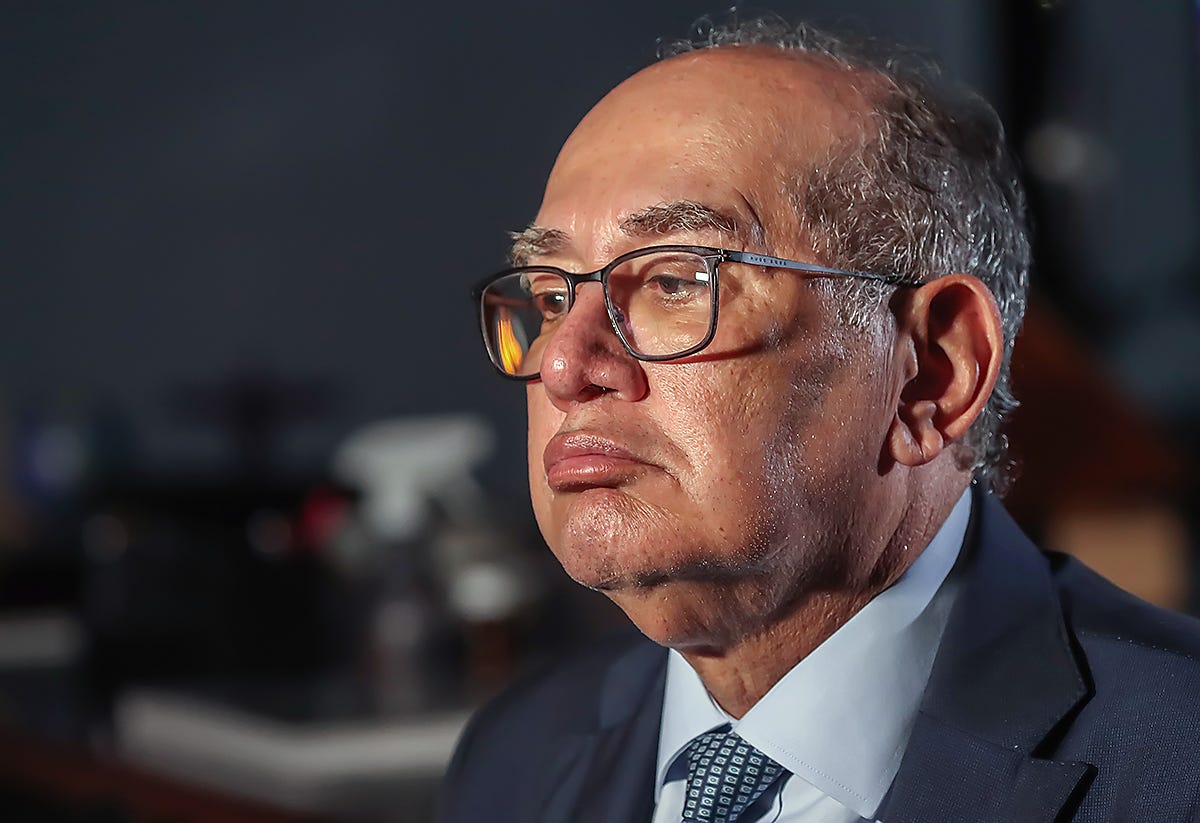
The reaction from the capital was unprecedentedly fierce. Judge Gilmar Mendes, one of the most powerful figures within the court and himself a target of the satire, responded in an interview with Renata Lo Prete of O Globo. Mendes called the video “deepfake propaganda” and demanded that Zema be included in the long-running inquiry into fake news.
What made the matter truly explosive, however, was a personal jab by Mendes during that interview. He made insinuations about Zema’s sexual orientation in a way that raised eyebrows even among his supporters. The criticism was so broad that Mendes later had to apologize publicly. The incident showed how deep the hostility runs; professional distance at the high court has completely vanished in this battle.
The gap between the robe and the street
Mendes was not the only one to lash out. Another anonymous justice let it slip that Zema’s attacks crossed legal lines and could even land him in prison. Mendes also defended the continuation of the controversial “Inquérito das Fake News,” which he believes must remain active at least until after the 2026 elections to protect democracy.
For Zema, this legal pushback is “political gold.” He positions himself as the brave outsider who does not bow to the “robes.” Many Brazilians are fed up with the authoritarian behavior of the justices, who in their eyes judge according to political convictions. Zema channels that discontent.
A high-stakes game
Zema is playing all or nothing. He has the support of the business elite and a rock-solid base in Minas Gerais, an economically crucial state. His challenge now is to translate that popularity to the rest of the country without getting caught in the legal nets of Brasília. He is betting that the voter in 2026 is not looking for a ‘Bolsonaro-light,’ but for an experienced administrator who combines the combativeness of the right wing with tangible economic success. The gap between the judiciary and the street has thus become the central theme of his campaign.
Dialect
According to the latest reports, Zema doubled down on the row with Gilmar Mendes. The latter had criticized Zema’s use of language (calling it a “dialect close to Portuguese”). Zema responded:
“Do you know why you don’t understand what I say, Gilmar Mendes? Because the language of ordinary Brazilians like me is different from the snobbish Portuguese of the untouchables in Brasília.”
The verbal battle between the ‘snobbish Portuguese’ of the capital and the ‘dialect’ of the ordinary Brazilian has thus become the definitive measure of an election struggle where they are fighting not only for votes, but also for the soul of the rule of law.
Photos: Marcelo Camargo - Valter Campanato/Agência Brasil
Stay updated. Click below to subscribe — free of charge.