

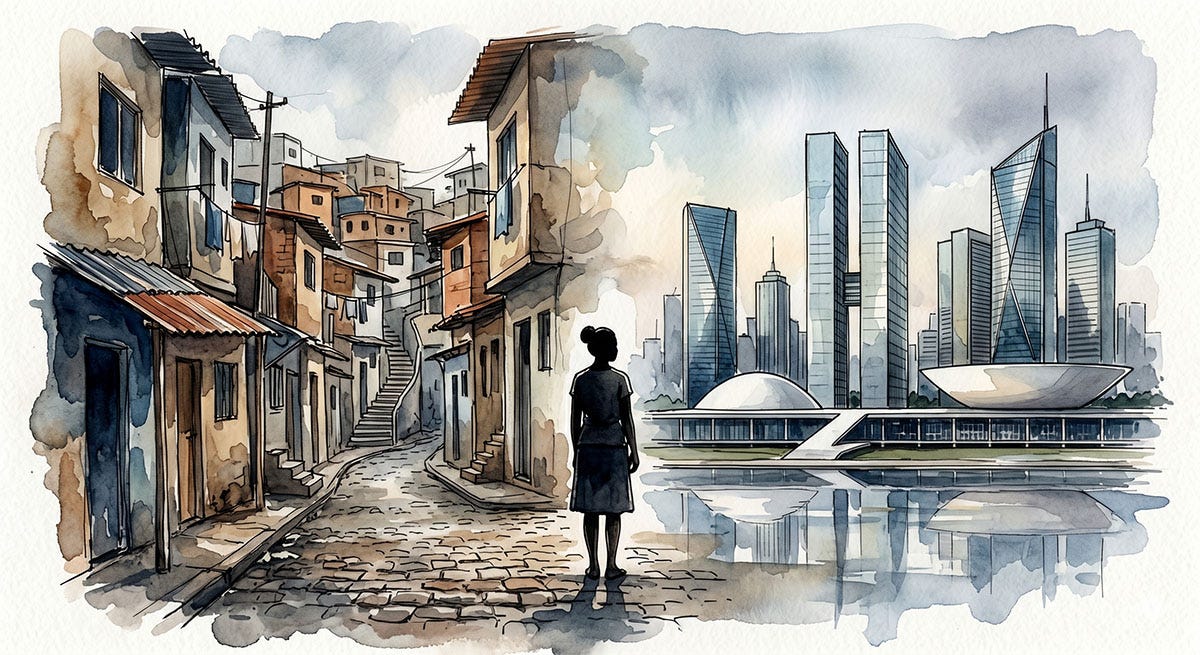
I didn’t get to know Brazil through beaches or samba, but through a crying woman in my circle of acquaintances. She was 38, beautiful, proud, religious, and poor. A woman who worked as an empregada doméstica for a minimum wage that was barely enough to survive. I had no idea she was being exploited. I only saw it later, and that insight brought an uncomfortable truth: I had meanwhile ended up in a world that I would only much later recognize as the Brazilian bourgeoisie.
One day she told me her story. She had been approached on the street by a woman who promised her a future as a model. Photos, a book, contacts with agencies, high wages. Hope, in short — the most precious possession of those who have little. She signed a contract she could hardly read. Only later did she discover that for a year she had to give up almost half of her wages for poor quality photos, without any guarantee of work. A pure scam.
When I took her to the “studio” and had the agreement torn up, I thought that was the end of it. But it wasn’t. The reactions from those around me were telling. Not directly to me — I was a foreigner, “someone who doesn’t yet understand how things work here” — but to her. Warnings, veiled threats, remarks like “those who climb high can have a long fall.” It was my first real confrontation with a social reality I hadn’t seen until then: a country where inequality is not just economic, but cultural, almost feudal. Where the powerful look down on those who have little, and where abuse is often seen as something normal, something that “just happens.”
I was indignant, but also powerless. At the same time, I began to understand how deep those structures ran. When Lula later rose to power, I wasn’t a fan, but I did see that he broke through something: the idea that power was only reserved for the same families, the same elites. But that hope, too, was later overshadowed by corruption scandals. Not because one party was bad, but because corruption in Brazil knows no ideology. It follows power, wherever it is found.
Perhaps that is why the recent story surrounding Banco Master, Daniel Vorcaro, and Ciro Nogueira affects me so much. Not because it is new, but because it reminds me of that small studio twenty years ago. The scale is different, the amounts astronomical, the buildings luxurious, but the logic is the same: those who have power, abuse it. Those who have little, pay the price.
For those who don’t know Ciro Nogueira: he is one of the most powerful politicians in Brazil. He leads the Progressistas (PP) party, a key party within the Centrão. That Centrão is not an ideological movement, but a power block that always aligns itself with whoever offers the best advantages at that moment. Under Lula, they were in the government. Under Dilma as well. Under Bolsonaro again — and Ciro Nogueira even became his chief of staff. Today they are negotiating again with the current government. Ideology plays no role. Only power, positions, and especially money.
And that is exactly where Banco Master comes in. The case involving banker Daniel Vorcaro is only at the beginning, but what is already coming to light is shocking. According to the investigation, Vorcaro paid enormous monthly amounts to Ciro Nogueira, through credit cards, companies, and luxury hotels. In exchange, the senator is said to have submitted bills that were literally written by the bank — proposals that would directly benefit the bank. It is a classic interaction between financial power and political power, but on a scale that is excessive even by Brazilian standards.
And this is only the tip of the iceberg. The more people stir the mud, the stronger the stench becomes. Vorcaro’s plea bargain is still under negotiation. No one knows which names will still fall, which structures will still collapse, which deals will still come to light. But one thing is certain: this is not an isolated incident. It is a system.
And once again I see the same dynamics as back then: those who criticize are warned. Those who ask questions are dismissed as someone who “doesn’t understand the system.” Those who are dependent are kept small. Only now the victims are less visible. Not a woman crying at a kitchen table, but millions of Brazilians who will never know why their lives are not moving forward, why their opportunities remain limited, why inequality is so persistent.
Twenty years ago, I helped one woman out of a trap. Today I see a country still trying to escape much larger traps, built by people who know better but still abuse their position. And yet, hope remains. Not the naive hope of promises, but the hope that justice — however slow — eventually gains the upper hand. That Brazil will one day become a country where no one has to fear those who “climb high,” because no one is being kept small anymore.
Hope keeps us alive. But justice makes countries move forward.