


Brazilian politics is currently in a turbulent phase in which economic choices and electoral survival strategies are becoming increasingly intertwined. With the general elections of October 2026 approaching, the debate surrounding the Taxa de Blusinha has grown into a symbol of the tension between the need to strengthen public finances and the desire not to lose the favor of the electorate.
This “blouse tax,” introduced on August 1, 2024 as a federal levy of 20% on international purchases under 50 dollars, was the result of years of pressure from the domestic retail sector. Companies such as Magazine Luiza and several industrial groups had long complained about unfair competition from Asian platforms like Shein, Shopee, and AliExpress. The Lula administration eventually gave in to this pressure in order to protect national industry, but the social and political cost turned out to be far higher than initially expected.
The introduction of the levy mainly affected the lower middle class and poorer segments of the population. For them, platforms like Shein had become a way to access clothing and consumer goods that are often unaffordable in Brazil. Due to the combination of the new federal tax and the existing ICMS state tax, the final price for consumers rose by nearly half. This sharp increase triggered a wave of indignation that severely damaged the government’s popularity. The situation was further aggravated by an unfortunate intervention by First Lady Janja Lula da Silva on social media.
She claimed that the tax would affect only large companies and not ordinary citizens. Economists and the public immediately responded that this did not reflect reality. Online criticism was relentless: countless memes portrayed the government as an institution completely detached from the daily reality of ordinary Brazilians.
In this context, the now-iconic nickname “Taxad” emerged for Fernando Haddad, the then Minister of Finance. While Haddad attempted to stabilize the economy through sweeping tax reforms, public opinion transformed him into the “Tax-man.” His image even appeared on international screens in New York, edited into parodies of films such as Batman and Harry Potter.
What began as a simple mocking nickname grew into a true flood of internet memes. Haddad was photoshopped into movie scenes and historical settings on social media, always with a tax-related twist. Brazilians are remarkably creative, especially when it comes to humor. Some examples include:
Tax-man: as Batman, but someone who collects taxes instead of fighting crime.
Harry Potter: “Harry Potter and the Prisoner of the Tax Office.”
Nostaxamus: a reference to Nostradamus, but predicting only new levies.
Tax Driver: based on the film Taxi Driver.
Although Haddad tried to put the public accounts in order, the image of tax collector clung to him stubbornly. This put his political capital under pressure. In March 2026, he resigned to focus fully on his candidacy for the governorship of São Paulo. His successor, Dario Durigan, inherited not only a complex fiscal landscape but also the electoral burden of the controversial import tax.
As the 2026 elections draw nearer, the debate over abolishing or easing the Taxa de Blusinha has flared up again. The government realizes that this tax poses a major obstacle to re-election, as a large majority of Brazilians see the measure as a direct attack on their purchasing power. The opposition eagerly exploits this by portraying the government as an enemy of the underprivileged. Behind the scenes, feverish efforts are underway to find ways to reverse the levy without completely alienating national industry. It is a classic Brazilian political chess game in which the economic logic of yesterday must give way to the electoral necessity of tomorrow, in the hope of restoring calm among millions of consumers before the polls open.
Looting of Shopee Truck
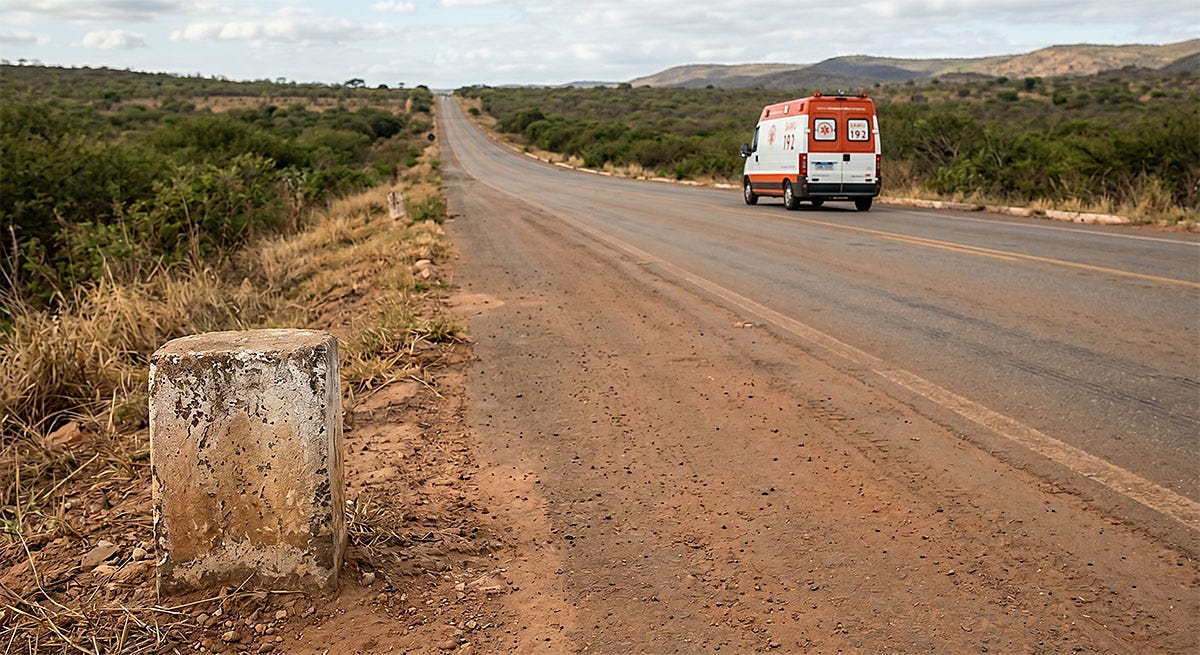
Yesterday’s accident on the BR-116 in Brejões (Bahia), in which a truck full of Shopee packages overturned and was almost immediately looted while the injured driver was still trapped in the wreckage, casts a harsh light on the current tensions within Brazilian society. This incident is more than a tragic news story; it stands in stark contrast to the political debates in Brasília over the Taxa de Blusinha. While politicians argue over percentages and import duties, the looting along the highway reveals a deep social fracture. I saw the footage myself on television, and although it was not the first time I had witnessed such scenes, it once again stirred a mixture of revulsion and understanding: revulsion at the brutality of the moment, but also understanding for the poverty that drives many to such acts and for the reasons why part of the population, despite counterarguments, continues to vote for a leader who, to them, fulfills almost the role of a kind of Santa Claus. At the same time, there is a growing fear that the disappearance of that figure may, for some voters, become a reason to resort to looting even more quickly in the future.
In regions such as Brazil’s Northeast, the relationship between citizens and the state is often marked by absence and neglect. For many people, an overturned truck does not feel like someone else’s misfortune but like a rare chance to obtain something normally out of reach. The greed visible here is often an expression of chronic scarcity, where the instinct for survival outweighs empathy. When the government, through measures like the Taxa de Blusinha, further restricts access to affordable goods, the feeling grows that the system actively works against the poor. In that context, looting the cargo of a multinational like Shopee is, for some, no longer seen as theft but as a form of “social compensation” for a life full of limitations.
This event casts political promises in a harsh light. While the Lula administration now considers abolishing the tax to win votes for the October 2026 elections, the incident on the BR-116 shows that the gap between citizens and the law runs deeper than a few percentage points of tax pressure. The “Taxad” memes and the debates over Janja’s statements feel almost abstract when confronted with the raw reality of people stepping over an injured man for a package of cheap clothing or electronics. It reveals a society in which the moral order has been eroded by structural inequality and a lack of social protection, allowing immediate individual gain to outweigh human solidarity.
The origins of this collective greed lie in the history of a country marked by vast differences between those who make the laws and those who bear their consequences. For someone unfamiliar with Brazil, it may seem incomprehensible, but within the Brazilian context it is a symptom of deeper suffering. The looted truck in Bahia is the violent expression of frustration over purchasing power. It makes clear that as long as a large part of the population feels excluded from the formal economy, the path toward a mature dialogue about taxation and civic responsibility will remain long and full of obstacles. Repairing this moral damage requires far more than simply scrapping an unpopular levy shortly before the elections.
Images IA generated