

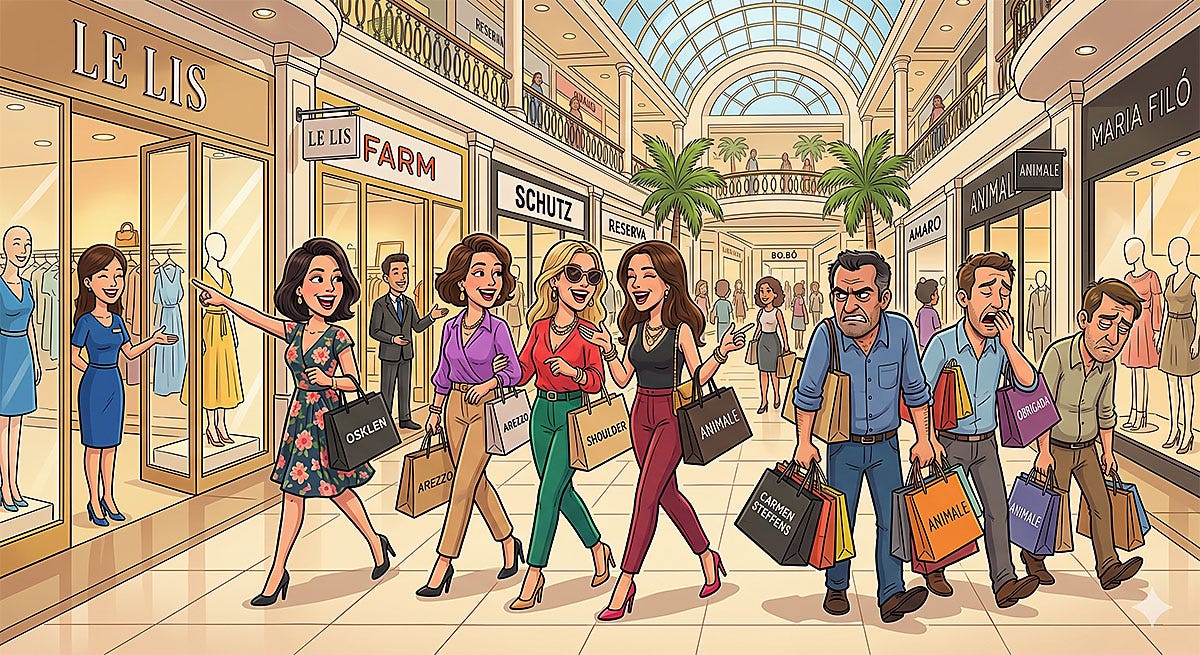
Which father or husband hasn’t experienced it? Women generally love shopping and can spend hours in a shopping mall. In Brazil, this is invariably described as a “Shopping”—a typical example of an anglicism. The English word was borrowed but is used in its own way as a noun, whereas an Englishman would always say “Shopping Centre.” Elsewhere, people speak of a Mall, Outlet, Plaza, Centro Comercial, Arcade, or Podium (in Asia). A fun linguistic fact: the word “Mall” originally comes from The Mall in London, a street where a game similar to croquet, called “pall-mall,” was once played. Because that street was a favorite place for walking, the word later became synonymous with a wide promenade, and eventually with the indoor shopping centers we know today.
In Brazil, too, it is mainly the ladies who go shopping, with or without a sometimes bored-looking husband. I am not going to analyze that; I’ll leave that to the psychologists. It is, however, a fact that the preference for the “Shopping” is also linked to safety and climate—factors that play a smaller role in Western Europe. In cities like Salvador, the shopping mall is the place where women can walk around without a care, meet up with friends, or go to the hairdresser without the risks or the heat of the street. As a result, the emotional bond with the shopping mall in Brazil is often stronger than in countries where the regular high street is safe and cool. There is also a specific class difference visible. Women from the wealthier class often visit in the morning, nowadays not seldom after a visit to the “academia” (gym). The working class uses the “Shopping” primarily as a real outing during the weekend.
However, it cannot be denied: Brazilian shopping centers, which for years held an untouchable position as safe and social meeting places, are currently in a difficult transition. The figures show a clear decline: since 2019, the number of monthly visitors has dropped by over 6%. The financial blow is even greater; although general figures might sometimes suggest otherwise due to inflation, real turnover has shrunk by a staggering 25% in that same period.
This development shows strong similarities to the situation in the United States and Western Europe, where the traditional mall has long been losing ground to the digital market. In Brazil, the shift to online shopping has moved into high gear. In 2020, a quarter of mobile phones were bought online; that figure has now risen to nearly half. For the average consumer, the internet simply offers more convenience and lower costs, as extra expenses for fuel, parking, and eating out are eliminated. Recently, total online sales in Brazil even surpassed the entire turnover of physical shopping centers.
Another major bottleneck is the efficiency of opening hours. Many shopkeepers are questioning the standard twelve-hour opening day. There are increasingly “lost hours” during which the public stays away almost entirely. While the evening hours after five o’clock used to be the busiest time of day, that peak has now shifted to the lunch break. The late hours between eight and ten in the evening yield almost nothing for many retailers, while labor costs and the costs of the enormous buildings continue in full.
Even the so-called “anchor attractions” of the shopping centers have lost their luster. Cinemas, which in Brazil are found almost exclusively in these centers, saw their audience decrease by 36% due to the massive popularity of streaming services. In addition, the rise of hybrid work presents a new challenge. On days when employees stay home, especially on Fridays, the decline in visitors is immediately noticeable.
The sector is trying to reinvent itself by focusing more on hospitality, events, and services, but so far without the hoped-for great success. Although new shopping centers are still being completed, the question remains whether this growth is sustainable. The structural change in consumer behavior seems irreversible: the shopping center is no longer the automatic destination for daily purchases.
According to the most recent data from the industry association Abrasce, Brazil currently has 658 shopping centers. Although the sector as a whole reported record turnover last year, this figure hides a great inequality. Nevertheless, another 11 new projects are planned for this year. Meanwhile, older or less favorably located centers must fight to survive.
It is truly a matter of adapting. Buying online has its advantages, such as convenience and often a lower price. But there are also disadvantages: when that new dress from Shopee or Shein arrives, it sometimes fails to meet expectations, or the size is wrong. In the “Shopping,” you can at least choose, look, touch, and fit. A Brazilian summarized it on social media as follows:
“Shopping centers need to understand that we want an experience. It’s not just about buying stuff. We want to stroll around and have fun. They build useless buildings that have absolutely no appeal. They all look the same; it’s as if the architects are lazy—just look at the Iguatemi chain, they are all identical. Moreover, because of the enormous size, we get lost when looking for a specific shop. Where are the signs? With all this modern technology, it makes no sense to get lost in a mall while trying to find a store.”
You just can’t win, can you?
Stay updated. Click below to subscribe — free of charge.