

There are crimes that make the news and then slowly fade. And there are crimes that linger, not because they were never solved, but because every attempt at solving them only raises new questions. The murder of Celso Daniel, mayor of Santo André, belongs to that latter category. More than twenty years later, it remains a story that refuses to end, a shadow stretching across Brazilian politics, across the history of the Workers’ Party, and across a country that has never been able to decide which version of the truth it should believe.
Celso Daniel was not just any politician. He was one of the intellectual architects of the Workers’ Party, a confidant of Lula, a respected administrator, a man who commanded admiration both inside and outside the party. He was a technocrat with a social conscience, someone who believed that governance was a form of science. And that is precisely why his death was so shocking: it felt as if one of the very foundations of the party had been ripped away.
The last evening
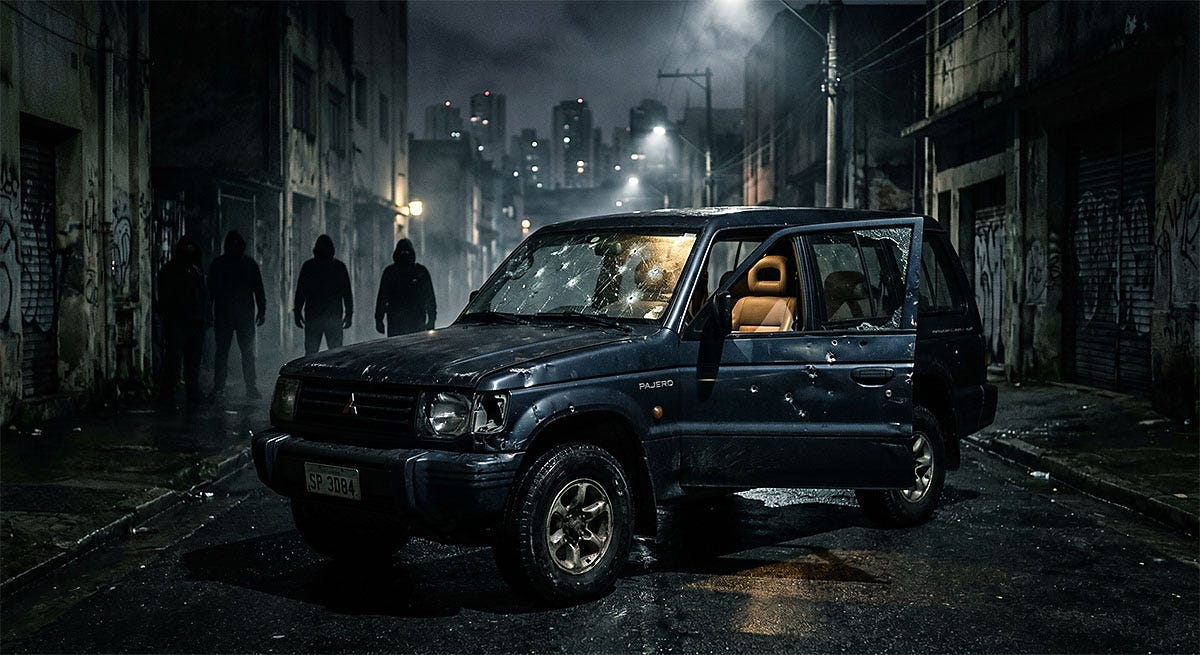
On January 18, 2002, Celso Daniel had dinner with his friend and adviser Sérgio Gomes da Silva, better known as Sombra, at a restaurant in the Jardins district of São Paulo. It was an ordinary evening, with no political agenda, no public appearances. The two men got into Sombra’s armored Pajero, a vehicle meant to guarantee safety in a city where kidnappings and robberies were far from rare.
But less than half an hour later, the car was surrounded by three vehicles. Shots rang out, glass shattered, and within seconds the mayor was dragged out of the car. Sombra remained behind, unharmed, in a vehicle that he claimed had suddenly stopped responding. Two days later, Celso Daniel’s body was found in a ditch along a dirt road in Juquitiba. Eight bullets had ended his life.
The official story
The police worked quickly. On April 1, 2002, the investigative team presented its conclusion: it had been a botched kidnapping carried out by a gang from the Pantanal favela. The criminals had supposedly intended to kidnap someone else, but after losing sight of their original target, they randomly chose Sombra’s Pajero. When they discovered that their victim was a mayor, they allegedly panicked. The gang leader reportedly said the victim should be released, but one of the members misunderstood the instruction and killed the mayor.
It was a story that fit neatly into a report. But not into the reality as many people knew it.
Cracks in the official version
From the beginning, there were elements that did not align with an ordinary kidnapping. No ransom was ever demanded — not from the family, not from the municipality, not from anyone. The Pajero showed no mechanical defects, even though Sombra claimed the car had suddenly stopped responding. The clothes in which Celso Daniel was found were not the clothes he had worn at dinner. And some forensic experts saw signs of mistreatment on the body, while other reports contradicted that.
The forensic doctor who examined the body, Carlos Delmonte Printes, stated that there were indications that could point to mistreatment, possibly even violence prior to death. Other experts disputed this. The result was a conflict between forensic reports that was never fully resolved. This contradiction was one of the reasons the family never accepted the first investigation.
The corruption that changed everything
But there was another element that made the story more complex — and that remains one of the most sensitive aspects of the case to this day. In the months before his death, Celso Daniel had reportedly gathered information about a corruption scheme within the Santo André municipal government. It involved bribes paid by transportation companies, money that according to some accounts was partly used to finance the Workers’ Party. That alone was explosive, but what made it even more dangerous was the claim that Celso Daniel had discovered that part of that money was no longer reaching the party, but was instead ending up in the pockets of individuals.
If that was true — and several witnesses later confirmed that an extortion system did exist — then Celso Daniel stood at a crossroads. He was a loyal party member, but he was also an administrator who believed in transparency and efficiency. According to his brother João Francisco, Celso had decided he could no longer remain silent. He had allegedly threatened to go public with his findings. He was even said to be working on a dossier mapping out the money flows. That dossier has never been found.
The political context — A party on the threshold of power
To understand why the death of Celso Daniel caused such a shock, one must return to the political climate of early 2002. Brazil was in a period of tension and transformation. The Workers’ Party, long an opposition movement that presented itself as the moral counterweight to traditional politics, was on the verge of its greatest victory. Lula was the clear favorite in that year’s presidential election. For the first time, power seemed within reach.
The party had always portrayed itself as the movement of ethics, transparency, and social justice. But by the late 1990s, it had matured — and with maturity came compromises. Municipalities had to be governed, elections had to be financed, campaigns had to be paid for. In that reality, tensions arose between ideals and practice. In several cities, including Santo André, rumors began circulating about opaque money flows, deals with companies, and a parallel financing system that did not always align with the party’s official rhetoric.
It was in this context that Celso Daniel operated. He was not just a mayor; he was one of the party’s strategists, someone who bridged the academic world, technocratic governance, and the political machine the Workers’ Party was becoming. He knew the internal dynamics, he knew the money flows, he knew the tensions between idealists and pragmatists. And according to several witnesses, he knew more than was safe for him.
A revelation of what he knew — if he truly intended to go public — could have plunged the party into an unprecedented crisis. It could have influenced the election. It could have derailed the Workers’ Party’s rise to national power at the very moment it was within reach. Whether that would actually have happened, we will never know. But the political stakes were enormous. And Celso Daniel knew exactly how sensitive that information was.
The family that refused to stay silent
The Daniel family did not believe the official version. His brother João Francisco stated that Celso had been working on a dossier about corruption in the Santo André government, involving party members. He later retracted part of his statements, but the doubt had already been planted. Another brother, Bruno Daniel, continued to push for a thorough investigation for years. He accused no one, but he did not believe his brother had been the victim of a random gang.
The result was that the story split into two parallel narratives: the official story of a botched kidnapping, and the alternative story of a murder with political or financial motives. Neither was ever definitively proven.
The second investigation
In 2005, a second investigation was opened. The gang members were questioned again. Some confirmed their earlier statements, others nuanced them. The police once again concluded that there was no political motive. The Public Prosecutor’s Office disagreed and continued to point to inconsistencies, unexplained details, and contradictory statements. But despite all efforts, no conclusive evidence emerged for either hypothesis.
The chain of deaths
Between 2002 and 2005, seven people connected to the case died. Some were witnesses, others suspects, others only tangentially involved. The waiter who served Celso Daniel on the night of the dinner died in a motorcycle accident while being chased. The only witness to that accident was shot dead twenty days later. A funeral worker who collected and identified the body was murdered. A police officer who had contact with one of the kidnappers was shot dead. And the forensic doctor who had reported signs of mistreatment was found dead in his office, officially by suicide.
The police treated each case separately. But for the public, for the family, for journalists, they formed a sequence that was hard to ignore.
A mystery without end
To this day, no one has been convicted of the murder of Celso Daniel. The case remains an open wound in Brazilian history. Not because it must be a political story, not because it must be a criminal story, but because it is a story that never received an ending.
What truly happened between January 18 and 20, 2002 remains unknown. Perhaps it was a botched kidnapping. Perhaps it was more than that. Perhaps some of the deaths were coincidences. Perhaps not. What is certain is that the official story never fully convinced, the alternative story was never fully proven, and the truth seems to hover somewhere in between.
And as long as that ending is missing, the mystery lives on.
personal note
When all of this happened, I had been living in Brazil for only two years. I was still adjusting to a country that, welcoming as it was, bore little resemblance to the quieter Europe I had left behind. If you were to chart the learning curve of an immigrant, I was barely at the end of primary school. I understood the language, I understood the people, but the political and social complexity of Brazil was still a world I could only observe from a distance.
On top of that, I was facing a personal tragedy at the time, something that consumed all my attention. It is not something I wish to discuss — not because it must remain secret, but because my private life does not belong in a public story. As a result, I only realized much later what had truly happened during those days. Even if I had followed the news — newspapers, television, conversations — I doubt I would have been able to grasp the proper context. I simply lacked the insight into the political reality of the country I had just arrived in.
But later, with the distance of years and the succession of scandals that would shape Brazil — the Mensalão, Lava Jato, and other affairs in which figures from the Workers’ Party repeatedly appeared — I began to see the puzzle pieces differently. You do not point a condemning finger, but you develop doubts. You see patterns. You see how power works, how systems protect themselves, how stories sometimes disappear into the folds of history.
And that is precisely why it became time to revisit this story, to dissect it and describe it. Not to condemn anyone, not to suggest a conspiracy, but to acknowledge that the protagonists of that time may deserve the benefit of the doubt, yet also bear the burden of later events that cannot be denied. It is in that tension — between doubt and caution, between facts and context — that the mystery of Celso Daniel continues to exist.