

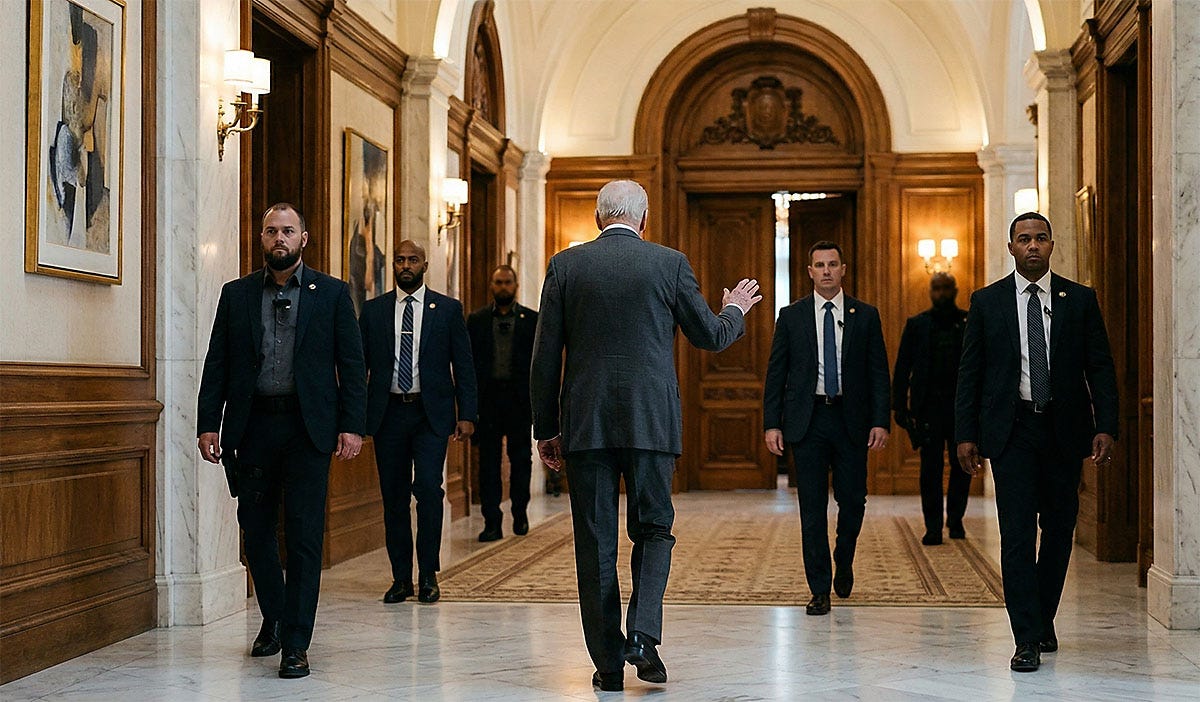
A human life consists roughly of two parts: a time of arriving, and a time of departing. The first part usually lasts longer than the second. But the second part meets with resistance. It took decades to learn everything, and you can lose it all in a matter of weeks, months, or a few years for a small but growing group.
Aging is a process that affects everyone, but not everyone in the same way. For many people, retirement means liberation: finally time, finally peace. For others, it is a shock. The loss of work is not just the end of a professional routine, but also of a role, an identity, a place in the larger whole. The feeling of “no longer being needed” is not a detail, but an existential experience that can cut deep.
This was also true for me. Despite an active life, despite the fact that I consciously continued working longer than strictly necessary, that moment still came. I found new activities, new ways to give meaning to my days — writing, walking, cooking, revitalizing my website. It helps, and it keeps me sharp. But the realization remains: growing older requires adaptation, humility, and the ability to make way for others.
And that is exactly where a question begins that has occupied me for some time. Because if ordinary citizens already struggle with letting go of their roles, what must it be like for people who have stood at the top of power for decades? For leaders of countries, for whom every day revolves around influence, visibility, decisions, and responsibility on a global scale?
In several countries, we see political leaders of a very advanced age who remain active in positions that require extreme mental sharpness. This is not a judgment on individuals, but an observation of a pattern. And that pattern becomes visible in public appearances, speeches, and interviews, where statements are sometimes made that raise questions about clarity, context, or judgment. Such statements are then shared en masse on social media — often without any nuance, without background, and without the circumstances in which they were made. A single sentence, ripped out of context, then becomes a weapon, a meme, a caricature. And that is exactly why I wonder whether societies should not only be protected against the risks of leaders at a very high age, but whether such leaders should also be protected against themselves.
To illustrate how vulnerable leadership can become at an advanced age in an era of permanent media attention, here are several statements that caused a stir nationally and internationally. These are not meant to ridicule individuals, but to make the pattern visible.
“You are the honest people who want me to be honest.” (Lula: an ‘ato falho’ or Freudian slip where he unintentionally suggested that he still has to become honest).
“Nikki Haley was in charge of security for the Capitol... we offered her 10,000 troops, she turned them down.” (Donald Trump during a rally in New Hampshire, January 2024. He confused his then-rival Nikki Haley with Democratic Speaker Nancy Pelosi).
“The Chinese eat dogs and do not have the problem of Brazilians who spend too much money on their pets.” (Lula: a recent statement that was both culturally inappropriate and politically clumsy given his own lifestyle).
“Where’s Jackie? Is she here? I thought she’d be here.” (Joe Biden: he asked for a deceased congresswoman during a conference where she was actually being commemorated).
“They’ve never found a paint that looks like gold. If you paint it, it doesn’t look good... I’m thinking of doing the corners in gold leaf.” (Donald Trump: an unexpected tangent about the interior of the White House during a serious briefing).
“I want to express my gratitude to the African continent for everything that was produced during 350 years of slavery.” (Lula, on his way back from a summit between the European Union and CELAC in Brussels. He made a stopover in Cape Verde to strengthen diplomatic ties with African countries).
“Today we received the news that after a football match, violence against women increases. That is unbelievable. If the man is a Corintiano, then it is okay.” (Lula: he tried to create an informal, almost friendly atmosphere by making a joke about his favorite football club. It was an attempt at self-deprecation — since he is a “Corintiano” himself — intended to lighten the heavy subject matter before re-emphasizing the seriousness of the issue).
“People with mental problems have a loose screw.” (Lula: this remark about mental health — April 2023 — shows a moment where the president uses informal language that is perceived as hurtful or insensitive by specific groups in society).
“Venezuela has more narratives than facts... The concept of democracy is relative for you and for me.” (Lula: he said this during a visit by Venezuelan President Maduro to Brasília. He was trying to minimize the criticism of Maduro’s authoritarian regime by suggesting that democracy is a matter of interpretation).
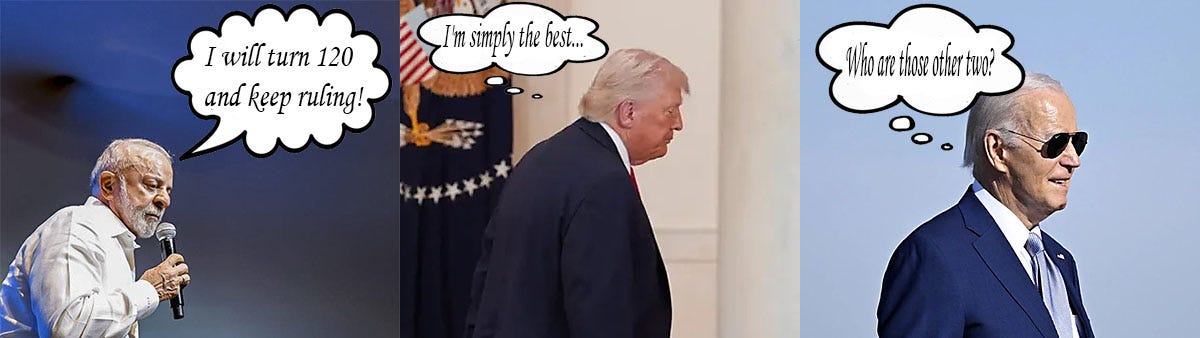
The core of the matter lies deeper than the statements themselves. It is not just about whether a leader of an advanced age still possesses the mental flexibility that the office requires. It is also about the consequences of every slip-up, every misunderstanding, every unfortunate phrasing. In an era where information circulates at lightning speed and where social media magnifies every mistake, a single sentence can have international repercussions. Leading a country is not a symbolic role. It is not a tribal council where older, wise men give advice based on experience. It is a position where decisions have an immediate impact on millions of people, on economies, on security, and sometimes even on world peace.
Therefore, an uncomfortable but necessary question arises:
Should societies consider a maximum age for positions with extreme responsibility?
This is not to disqualify the elderly, but to protect systems against the risks that inevitably increase as the years pass. Some institutions, such as the Brazilian STF, already have such a limit. The judges of that court are required to retire when they reach 75. In politics, that obligation does not exist. In international conflicts, we see how the decisions of world leaders — regardless of their age — can have enormous consequences. When such decisions are made by leaders at a very high age, the question arises whether systems provide sufficient safeguards.
Power is addictive. It provides structure, meaning, and a purpose. For someone who has been at the center of attention their entire life, the idea of letting go can be unbearable. But responsibility requires more than experience alone. It requires mental flexibility, responsiveness, memory, and clarity — qualities that, without exception, come under pressure for everyone as the years progress.
It is time to have that conversation — not out of fear, not out of partisanship, but out of common sense and care for the future.
Pictures AI generated - Reproduction Instagram
Stay updated. Click below to subscribe — free of charge.