

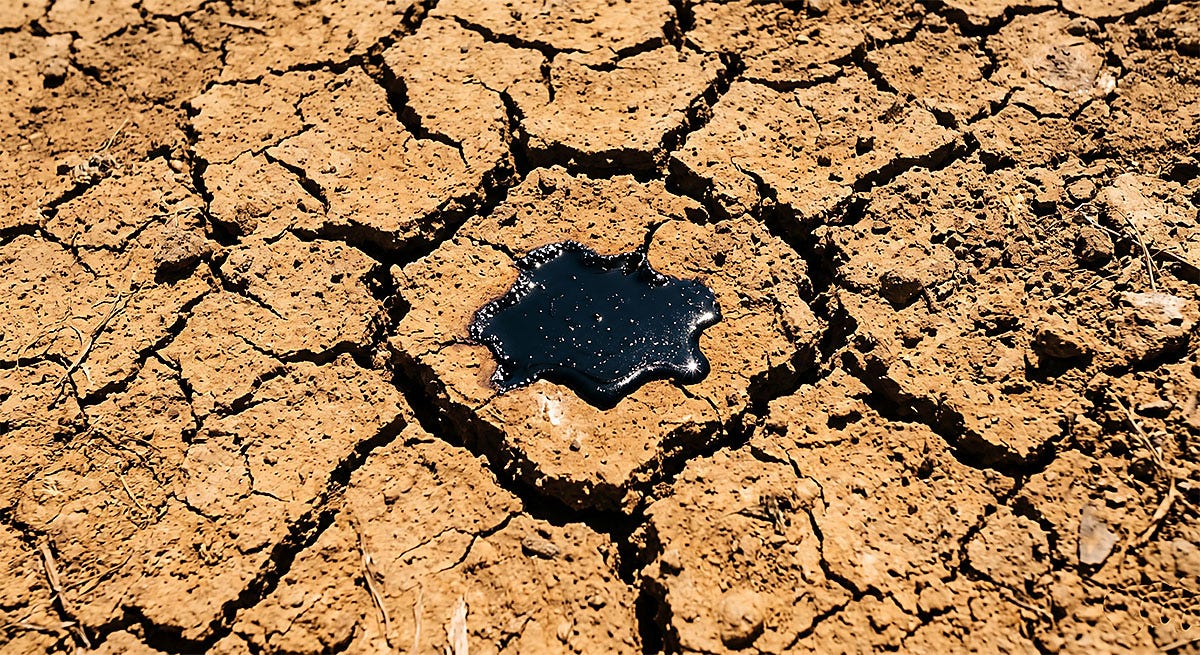
In the interior of Ceará, where the earth cracks open like a broken clay pot and the air shimmers under a sun that never seems to relent, water is not a given but a daily struggle. The Sertão lives at the mercy of increasingly unpredictable rains, as if nature itself no longer keeps its promises. For Sidrônio Moreira, a farmer whose entire life depended on the whims of the climate, the lack of water eventually became unbearable. His crops failed more often than they succeeded, his animals suffered from thirst, and his family lived in constant fear that the next drought would break them for good.
It is a paradox that remains difficult to grasp: Brazil holds one of the largest freshwater reserves in the world. The Amazon alone sustains a water cycle that renews itself endlessly, fed by rainforests that function like a giant pump. Beneath the ground lie aquifers such as Alter do Chão, among the largest and most sustainable on the planet. And yet a farmer in Ceará must take out a loan just to search for water. The contrast is so sharp it almost hurts: a country overflowing with water, where millions still live with thirst.
A Leap into the Unknown
Because the government offered no solution, Sidrônio decided to act on his own. He borrowed fifteen thousand reais — for him, the equivalent of years of work — to drill a well. It was an act of desperation, but also of stubborn hope. If he found water, his land could become fertile again. His children would no longer have to carry jerrycans. His future might finally feel a little less fragile.
The drill went into the ground. Ten meters. Twenty. Thirty. Eventually forty meters deep. Each additional meter meant more tension, more cost, more hope. And then, on a day he would never forget, liquid rose to the surface. Dark, thick, but in the first seconds Sidrônio thought it was simply mud mixed with water. He called his family. They cheered. They danced. After years of drought, it seemed water had finally been found. It felt as if the earth itself had taken pity on them.
The Discovery That Changed Everything
But the joy did not last. The smell was wrong. The texture too. The liquid did not evaporate; it clung to everything. The technician frowned. Neighbors came to look. And slowly it became clear: this was not water. It was oil.
The shock was immense. Oil, in the imagination of many Brazilians, is a symbol of wealth, of Petrobras, of national pride. But for Sidrônio it was above all a disappointment. He did not need oil. He needed water. Oil could not save his crops. Oil could not quench his children’s thirst. The irony was almost cruel: a man searching for water finds oil — and remains thirsty.
The Bureaucratic Maze
Sidrônio reported the discovery to the authorities. First to the local government, then to the ANP — the Agência Nacional do Petróleo, Gás Natural e Biocombustíveis — the federal agency overseeing oil and gas activities. The CPRM, Brazil’s geological service, was also notified. And then the silence began. Weeks turned into months. Months into more than a year. In total, it took nearly two years before the ANP officially confirmed that the substance was indeed oil. Not because the analysis was complex, but because bureaucracy is slow, fragmented, and understaffed. In reality, the process could have been completed in a matter of weeks.
Meanwhile, Sidrônio remained without water. His well was sealed pending investigation. His loan continued. His land stayed dry. The oil beneath his feet changed nothing about his daily struggle. It was as if the state had left him in a waiting room with no doors.
Brazil’s Great Water Paradox
Sidrônio’s story exposes a painful paradox. Brazil holds twelve percent of the world’s freshwater, yet this abundance lies thousands of kilometers away from the regions that need it most. The Northeast, historically dependent on rain and small reservoirs, remains vulnerable because it was never structurally connected to the water masses that define the country’s hydrological wealth. This geographic inequality is not a natural phenomenon but the result of political decisions layered over generations.
In the 2000s, President Lula launched an ambitious project to divert water from the São Francisco River — the “river of national integration” — to the drought-stricken Northeast. It was a megaproject meant to supply millions with water, an attempt to bridge a historical divide. But as so often in Brazil, the project was delayed by bureaucracy, corruption scandals, technical setbacks, and political turnover. When Bolsonaro later inaugurated parts of the project, he presented it as his own achievement, claiming he delivered what Lula had failed to finish. Yet even today, the water reaches only a fraction of the communities that need it. For many, like Sidrônio, nothing changed.
The contrast with other countries is striking. In the Middle East, where water is even scarcer, nations like Israel and the United Arab Emirates invested in large-scale desalination plants, drip irrigation, and water recycling. They built systems that do not depend on rain or political volatility. Brazil, despite its natural abundance, has never felt the same urgency — and that lack of urgency leaves deep scars.
The Rules of Oil and the Price of Patience
Even now that the oil has been officially confirmed, the question remains: what does it bring Sidrônio? Under Brazilian law, oil belongs to the federal government. The landowner has no right to the oil itself, only to a royalty of at most one percent of the revenue — and only if the field is commercially developed. And that is far from guaranteed. Developing a small onshore field is a long, expensive, and complex process. It may take years before any company shows interest. It is entirely possible that Sidrônio’s one percent — if it ever materializes — will go not to him, but to his heirs.
The Human Toll
For Sidrônio, the mix of emotions remains difficult to grasp. He found something that could be worth millions, yet it brings him nothing today. He experienced a moment of joy that turned into disappointment. He became the subject of news stories, but his daily reality remained unchanged. He did not want oil. He wanted water. He wanted to make his small piece of land fertile. He wanted security for his family.
His story is not an exception. It is a mirror. It shows how poverty and wealth coexist, how natural abundance does not automatically translate into well-being, how bureaucracy slows lives down, and how the future of energy does not always align with the reality of people who need water today.