

There is, in Brazil, a wall no one sees — but sooner or later, you feel it. Not because it’s hard, but because it’s soft. It’s made of sounds, habits, rhythm, accent. A wall that wasn’t built to keep anyone out, yet forces you to stop and listen. It’s the wall where English simply doesn’t work, even among people who studied it for years, even among those who know the grammar, even among those who understand almost everything. Speaking is still difficult. Not out of shame or lack of interest, but because Brazilian Portuguese is a language that lives in the body — in the muscles, in the mouth, in the melody.
I never laughed at that. And no one laughed at me when I made mistakes — sometimes very silly ones. Portuguese is beautiful, but it isn’t easy. You have to live inside it, breathe inside it, trip over it. And even then, it remains a challenge. In my professional life, I’ve noticed that even highly educated Brazilians sometimes don’t write perfect Portuguese in their emails. Not because they don’t know the rules, but because the Portuguese they speak isn’t always the Portuguese they write. That’s not a flaw — it’s proof that the language here is alive, moving, adapting to the speaker.
And then come the sounds. The sounds that rule everything. Fiat becomes “Fee-aht-shee.” WWW becomes “dáblio-dáblio-dáblio.” FM becomes “Effie-Emmie.” And my last name, Smeets, inevitably turns into “eSchmiets,” as if the initial S needed a running start. Curiously, no one struggles with Shopee or Shein — words that many Europeans find almost tongue-twisting.
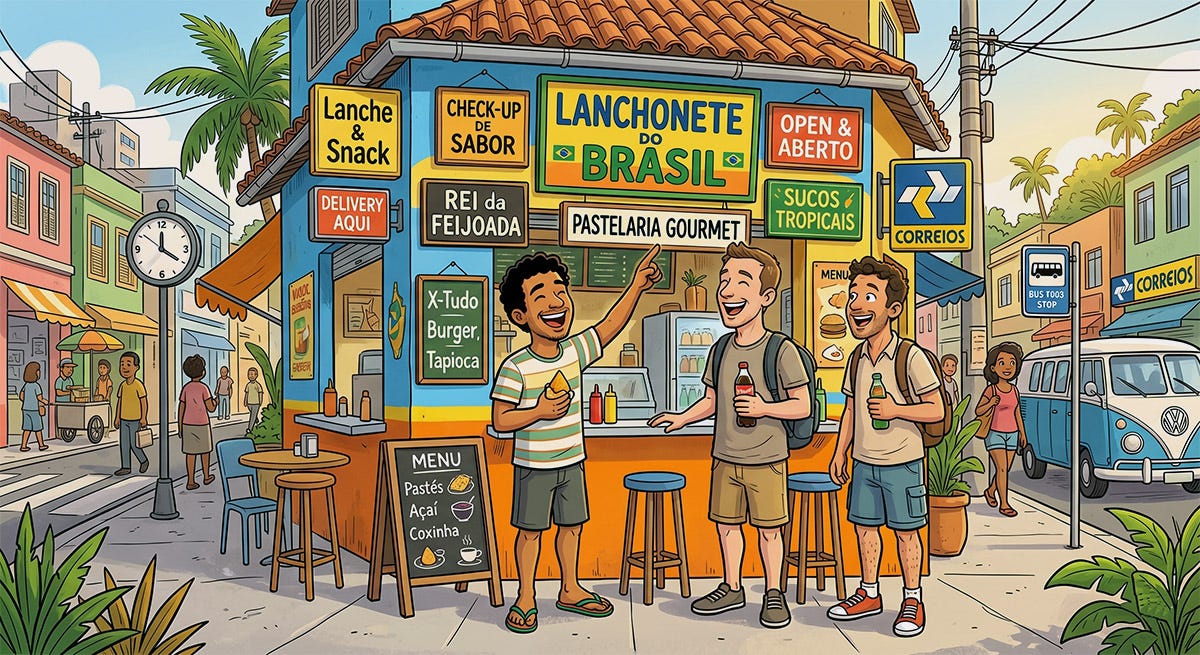
What fascinates me most is how Brazilians use English words constantly in everyday life — not as a language, but as decoration, style, marketing. Delivery, feedback, check-up, outdoor, fitness, post, like, selfie, snack — the last one not meaning the food, but the place where you buy snacks. And then there are the local inventions, like a clinic in my neighborhood called Labchecap, a blend of “laboratory” and “check-up,” a name that makes anyone frown the first time they see it, yet fits perfectly into the Brazilian habit of mixing words until something new emerges.
This creativity shows up everywhere. In Bahia, Oh Meu Rei (“Oh My King”) is a classic expression of affection or surprise, and Bahea is a shout of pride. You greet someone with Axé — a word full of energy and blessing — and you say goodbye with um cheiro, literally “a smell,” but actually meaning a warm, affectionate hug. In Rio, you hear mermão (“my brother”), in Minas Gerais it’s uai, in the South you become tchê, in São Paulo it’s meu, and across the country sentences end with cara (“man,” “dude”).
One of the most memorable moments for me was seeing a sign above a shop: Rei dos Bancos — “King of Banks.” I didn’t have a bank account yet, and for a second I wondered if that was where I should open one. Of course not. The man was the king of car seats. Later I found variations like King of Seat Covers, Queen of Leather Seats, and King of Feijoada, a restaurant where people waited on the sidewalk for a table on weekends. I went once. It was truly excellent.
For a foreigner, all this might seem merely curious, but for me — someone who lives here — these are windows into a people who don’t just use language, but play with it, bend it, mix it, reinvent it. A people unafraid to experiment, who prefer creativity over perfection. And to be fair, we foreigners are no better. We stumble over pão, não and pau — three words so natural to Brazilians that they can’t understand how we manage to confuse them. But we do. For years. Sometimes forever.
But this isn’t a text about differences. It’s a text about closeness. About how Brazilians and non-Brazilians can meet each other even when language seems to get in the way. I learned Portuguese in the era of cassette tapes, a few books, newspapers I forced myself to read from day one, TV programs I understood half of but watched anyway. Today everything is different. Modern translation tools make language learning far more accessible. Artificial intelligence accelerates the process even more — practical, powerful, enriching. It would be a waste not to use these tools, and unfair if part of the population couldn’t access them.
That’s why I insist: digital inclusion is not a luxury — it’s a necessity. Everyone deserves access to the tools that bring people closer. No one should be excluded from the possibility of learning, communicating, connecting. We all live on the same planet, we need each other, we are even obliged to collaborate and to be patient. Language is not a wall that separates us, but an invitation to meet.
That is the invisible wall. It isn’t hostile, it isn’t hard, it wasn’t built to keep anyone out. It’s a wall that says: if you want to live here, you need to pass through me. And those who do discover something beautiful: behind that wall there is no barrier at all, but a world that opens only to those willing to listen, practice, make mistakes, and try again. A world where language isn’t an obstacle, but a bridge. A world where creativity matters more than perfection. A world where Brazilians and non-Brazilians don’t just understand each other — they enrich each other.
When I came to Portugal 35 years ago it was very hard to even try and interact in Portuguese because few people were used to "estrangeiros" speaking Portuguese. They either went into a panic, called their 5 year old son who they said was learning English at school, or tried their best to speak mostly incomprehensible English words. It wasn't until I joined the Brazilian community in Carcavelos (via a Brazilian boyfriend) that I could join in a conversation - because people just responded - in playful and generous ways - to the sounds coming out of my mouth, the gestures I made, the expressions on my face. I felt like a person engaged in a buzzing atmosphere of things going on - rather than a intruder disrupting the flow of how things were. It taught me a lot about language, acceptance and identity.
It’s not easy for a Flemish speaker to learn Brazilian Portuguese but I try. I do understand most of it when they talk as long as they don’t use the local dialect because then they could be talking Chinese. I am always afraid to speak because of the fear of making myself a laughing stock but I shouldn’t. My husband is Brazilian and we talk mostly in English to each other but we also have our own language Brazilianflemishenglish you could say. Because I am not so young anymore it is hard to learn a new language, but I am willing and trying.☺️