

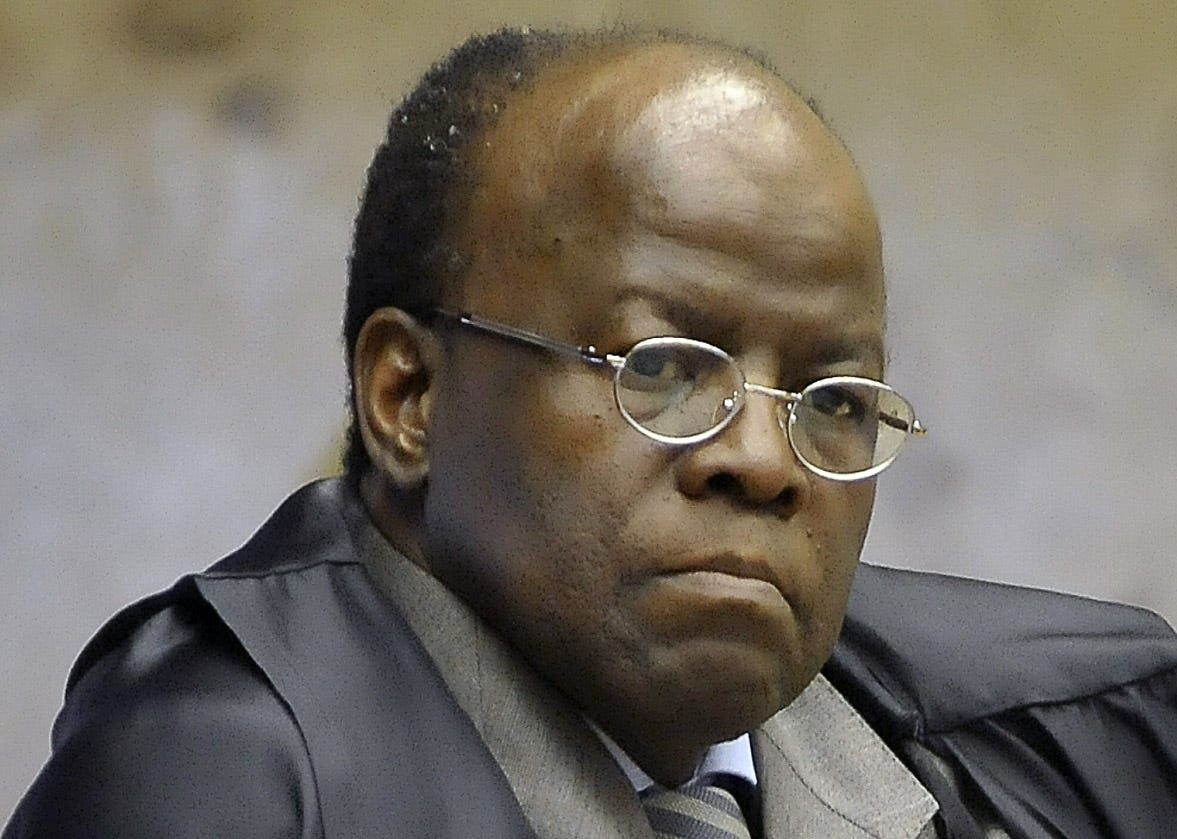
There are moments when Brazilian politics behaves like a novel writing itself. Events do not merely follow one another; they seem to arrange themselves into a pattern almost too coherent to be accidental. As the cesspool surrounding Banco Master continues to open, as Flávio Bolsonaro once again finds himself embroiled in scandal, as the Lula administration increasingly evokes the image of a government struggling to connect with a country eager to move forward, a figure long absent suddenly reappears. Joaquim Barbosa, the man who once shook the Supremo Tribunal Federal, steps back onto the stage. Not as a commentator, not as a distant moral beacon, but as a member of a political party.
That is no minor detail. It is a break with his own history.
Barbosa, now 71, is one of those rare figures who possess not only a career but a story. Born into poverty in Minas Gerais, self-taught, a polyglot, a man who carved his way to the highest judicial office in the country through discipline and intellect. During his eleven years on the Supreme Court, he became the face of the Mensalão case, a moment when Brazil briefly believed that justice was possible even when powerful figures were at stake. His conduct was strict, at times severe, but always marked by a sense of institutional seriousness that in Brazil is more exception than rule.
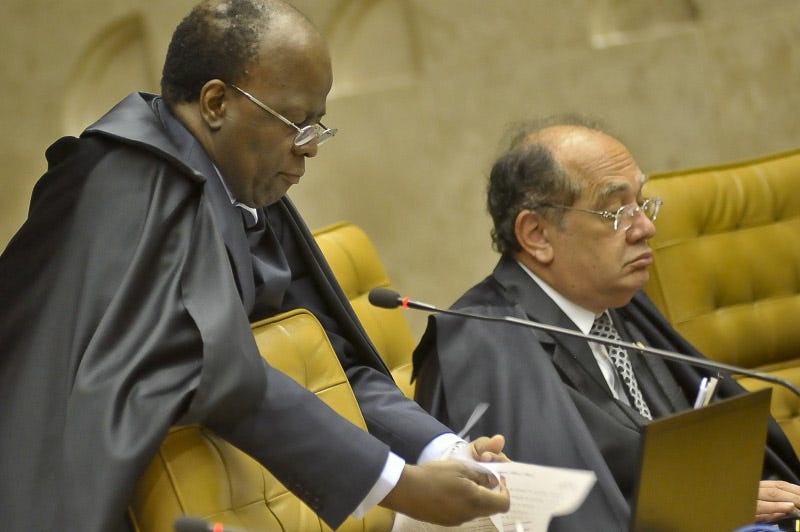
Anyone who lived through that period also remembers his physical struggle. Barbosa suffered from severe back pain, so intense that he often stood behind his chair during sessions because sitting had become unbearable. He cited that pain as the official reason for his departure in 2014, and no one doubted it played a role. But behind the scenes, other stories circulated. Rumors of threats, of pressure, of enemies he had inevitably made through his uncompromising stance in the Mensalão scandal. It was a time when the Supreme Court had not yet reached the state of permanent siege it faces today, but the risks were real. And anyone who now sees how justices can barely appear in public without bodyguards, how they are insulted in the streets, how their safety is constantly at risk, understands that those rumors were not born out of thin air.
After leaving the Court, Barbosa withdrew. He did not disappear, but he chose a life at a distance: consulting work, lectures, study, a certain peace he had earned. In 2018, his name resurfaced when the PSB considered him a potential presidential candidate. Speculation was intense, expectations high, but in the end he declined. He said it was not the right moment, and perhaps it wasn’t. The country was then in the grip of a different dynamic, a different hysteria, a different polarization. His refusal was read as caution, as wisdom, as self-knowledge.
That makes his current move all the more remarkable. Anyone who joins a political party — in this case the Democracia Cristã* — knows it will not go unnoticed. Barbosa is not a man who stumbles into a political structure by accident. He knows his name will immediately be seen as a potential candidacy. He knows a small party with no resources does not invite him for a casual chat. He knows his affiliation will be interpreted as a signal, even if he himself remains silent.
And yet he did it.
It is tempting to see in this convergence of circumstances a kind of historical logic. While the Bolsonaro clan is once again dragged into a scandal exposing its moral emptiness, while the Lula administration increasingly evokes the image of a government struggling to meet the needs of a country that wants to move forward, while voters grow weary of the endless repetition of the same conflicts and the same names, Barbosa reappears — a figure untainted by political mud, carrying a reputation for integrity, and embodying a life story recognizable to millions of Brazilians.
That he is Black adds a dimension no one can ignore. Brazil, a country that likes to present itself as a racial democracy but where reality often tells another story, has never had a Black president in the modern democratic era. The symbolism of such a possibility is enormous, even if for now it remains no more than a thought experiment.
But that is precisely why it is important to remain sober. In 2018, there was hope, speculation, fantasy. Barbosa chose not to run. The same could happen now. The DC may dream, others may as well, but dreams are not facts. The political landscape is unpredictable, and Barbosa is someone who sets his own pace, not that of the parties eager to use him as a lifeline.
What is happening today is nothing more and nothing less than a signal. A signal that the old structures are trembling. A signal that space is opening for something different, something not trapped between the fatigue surrounding Lula and the scandals surrounding Bolsonaro. A signal that Joaquim Barbosa, after years of silence, senses that the country once again stands at a crossroads.
Whether he chooses to cross it is another matter. But that his name is being spoken again, at this moment, in this context, says enough about the state of Brazil.
*The party
Although the Democracia Cristã is a small party, nearly invisible amid the noise of Brazil’s major political machines, it carries an ideological heritage far clearer than its electoral weight suggests. It is rooted in the Christian-democratic tradition, a current that has always moved between moral conservatism and social responsibility, rejecting extremes, rejecting ideological hysteria, and emphasizing human dignity, family, solidarity, and a state that protects without suffocating. It is not a radical party, not a populist movement, not a neoliberal enterprise, but a moderately center-right home grounded in principles older than today’s political polarization. And that is precisely why it is so striking that Joaquim Barbosa has chosen to join this party. He knows it is small, that it has almost no resources, that it has no television time, and that without him it stands no chance of being heard nationally. But he also knows that its ideological tone — institutional seriousness, moral clarity, rejection of extremes — lies close enough to his own reputation to be credible. A man like Barbosa does not join a party that compromises him; he chooses one that does not get in his way. That makes his move no less enigmatic, but far more understandable: if he is willing to open even a crack in the political door, he will do so with a party that will not swallow him, but allow him to remain himself.
Pictures: José Cruz / Agência Brasil