

Brazil is overflowing with churches. In every neighborhood, every street, every favela, you find them: from impressive cathedrals to simple rooms with plastic chairs and a loudspeaker. Brazilians are generally deeply religious, and they have no shortage of options to practice their faith. There is nothing wrong with that — on the contrary, anyone who spends time in Brazil quickly notices how strongly faith is woven into daily life. Even those who consider themselves atheists cannot escape the language of belief. Expressions like “Meu Deus do céu!”, “Deus sabe todas as coisas”, “Se Deus quiser” and “Meu Deus!” are heard everywhere, naturally embedded in everyday conversation.
But behind this warm, human religious culture lies a rapid and profound shift. The traditional Catholic majority is shrinking, while evangelical-Protestant churches are growing explosively. According to official data from the Brazilian Institute of Geography and Statistics (IBGE), the share of Catholics fell from 65.1% in 2010 to 56.7% in 2022. In the same period, the number of evangelical believers rose from 21.6% to 26.9% — more than 47 million people. Recent independent polls estimate that this share is now approaching 31% to 33%.
The rise of these churches, especially Pentecostal and neo-Pentecostal movements, is most visible in large cities and in the slums. There they offer not only religious services but also social support, practical help and a sense of community. They also manage to attract many young people, while the Catholic Church has an aging membership. Regionally, Catholicism remains strongest in the Northeast and South, while evangelical growth is concentrated in the North and Central-West.
Sociologists expect this shift to continue in the coming years. By around 2030, the number of evangelical Christians may even equal the number of Catholics. This growth also has political consequences. The evangelical caucus in parliament has become a powerful force that votes as a single bloc on moral and social issues. Politicians need their support to get laws passed. Moreover, many large churches own their own media — radio, television, internet — allowing them to influence millions directly. For any politician, the evangelical electorate is therefore a strategic key group.
But this growth also has a darker side. It cannot be denied that many self-appointed bishops, pastors and apostles abuse the trust of their followers. They present themselves as intermediaries between people and God, but in practice often function as a kind of toll gate on the “Stairway to Heaven.” Anyone who wants God to bless their life must pay — and not a little.
The dízimo: a sacred duty or a system of pressure?
The dízimo, the required payment of ten percent of one’s monthly income, plays a central role in many evangelical churches, especially in the neo-Pentecostal movement. Preachers base this on Old Testament texts, such as the book of Malachi, which calls on believers to bring a tenth of their harvest to the temple. In their theology, the dízimo is not a voluntary donation but a divine command and a sign of loyalty.
In practice, this creates a system of social and psychological pressure. The dízimo is tied to the so-called prosperity gospel: those who give will be rewarded by God with money, health and success. Those who do not give block God’s blessing — or even risk misfortune. During services, this is often presented theatrically, with testimonies from people who supposedly experienced “miracles” after giving money. For people with very limited income, this creates a painful situation: they feel guilty if they cannot contribute, afraid of being excluded from the community or losing God’s favor.
Although the dízimo is officially voluntary, the intense preaching and social control make it function in practice as a moral obligation. And it is precisely through this mechanism that figures like Valdemiro Santiago, R.R. Soares, the couple Estevam and Sônia Hernandes, Silas Malafaia and Edir Macedo have amassed enormous fortunes. They live in homes that resemble castles, own private jets, ranches and millions in bank accounts — not only in Brazil but also abroad. Meanwhile, their churches rise as monumental buildings in major cities, while many of their followers live in slums.
Edir Macedo is today one of the most powerful religious figures in Brazil, but his story began very simply. He was born in 1945 in a small town in the state of Rio de Janeiro and grew up in a Catholic family. As a young man, he made a sharp turn: he left the Catholic Church and joined evangelical Protestantism. He worked for years as an ordinary civil servant, behind desks in state institutions, until he decided that his future lay in religion.
In 1977, together with his brother-in-law, he founded a small church in a rented space that had once been a funeral home. The church was named Igreja Universal do Reino de Deus, or IURD. What began with a few plastic chairs and a handful of people quickly grew into a religious enterprise that spread across Brazil. The services were loud, emotional and aimed at people who were struggling: the poor, the sick, the unemployed, those seeking hope. The message was simple and powerful: those who believe, obey and give money will be blessed.
Giving money — the dízimo, ten percent of one’s income — was presented as a sacred obligation. For many people, this meant giving up part of their already meager wages. While the believers remained in poverty, the church grew into an enormous and wealthy organization. And at its head stood Edir Macedo.
His power increased even further in 1989 when he bought a nearly bankrupt television station: Record TV. Under his leadership, the station became one of the largest media companies in the country. From that moment on, Macedo not only had a church but also a voice that reached millions of Brazilians every day. He used that power to promote his church, spread his ideas and strengthen his political influence.
But behind that success, controversy was always present. Over the years, Macedo was accused of fraud, abuse of trust, illegal healing practices and manipulating believers to give more money. He was arrested, although some cases were later dismissed. Still, he continued to grow, becoming richer and more powerful.
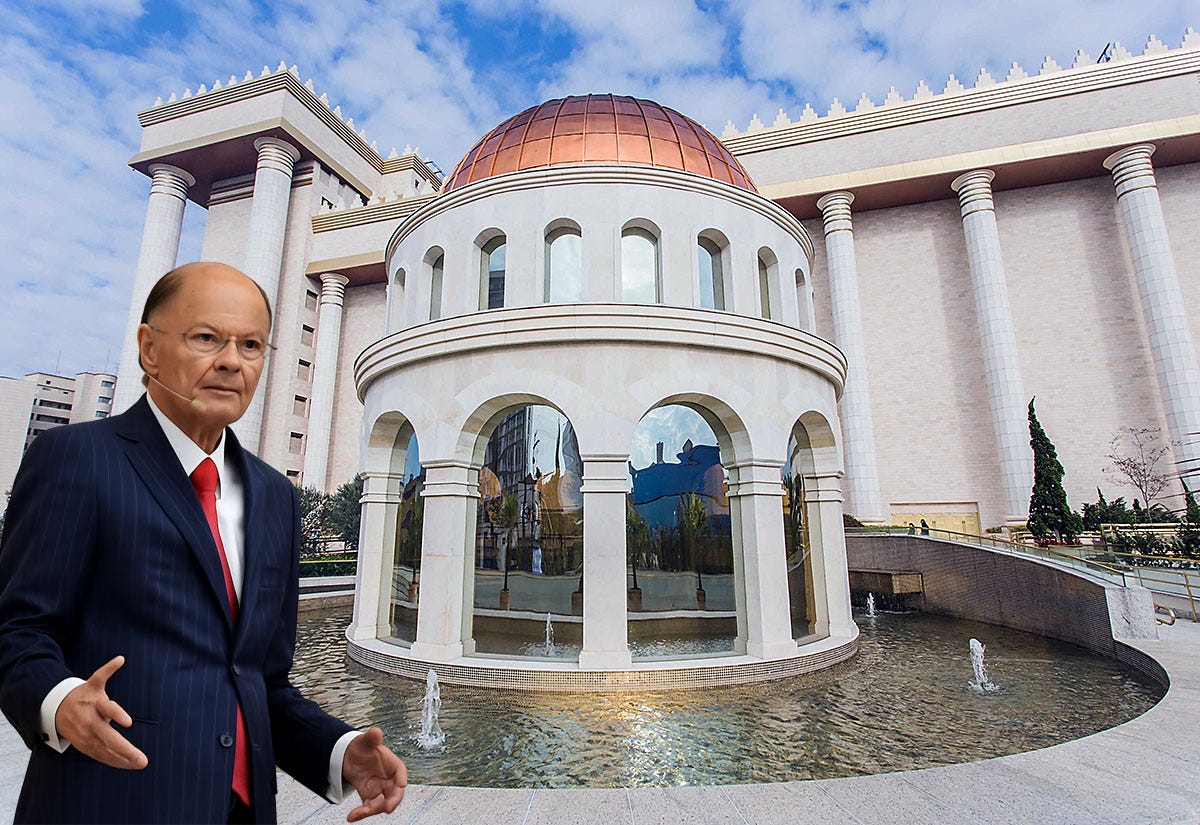
In 2014, he opened the Templo de Salomão, a gigantic religious complex in São Paulo designed as a modern replica of the Biblical Temple of Solomon. The building radiates wealth and power — a stark contrast to the poverty of many of his followers.
The step into the financial world
In 2020, Macedo took a new step: he bought a bank. It was the old Banco Renner, which he renamed Banco Digimais. The bank moved from southern Brazil to São Paulo and received a new mission. According to people close to him, Macedo wanted to use the bank to centralize the financial flows of his church and businesses.
But things went wrong from the start. The bank struggled financially, constantly needed cash injections and tried to stay afloat through risky investments and high interest rates on savings products. As problems mounted, Macedo tried to sell the bank. First to a businessman who later became embroiled in scandals himself, then to BTG Pactual, a major investment bank. But the sale stalled because Digimais failed to meet the conditions and because more and more questions arose about the bank’s true financial state.
Yesterday’s news: Operation Miragem
On June 23, 2026, the Brazilian federal police raided Digimais. Nine search warrants were executed, and a judge authorized the freezing of 670 million reais in assets. According to the police, those involved had manipulated the bank’s financial reports to hide its real situation. They allegedly altered figures to create the impression that the bank was healthy, when it was not.
The investigation shows that Digimais invested billions in funds whose financial documents could not even be audited. Some of these funds increased on paper by 178% in just a few months, without anyone being able to explain how. As a result, the bank recorded artificial profits while in reality sinking deeper into trouble.
The situation became so serious that credit rating agency Fitch refused to continue rating the bank — simply because there was too little reliable information. The future of Digimais now lies entirely in the hands of the Brazilian Central Bank. A sale seems increasingly unlikely, and a forced closure is not out of the question.
A recurring pattern
The story of Digimais fits into a broader pattern in Edir Macedo’s life: a constant combination of religious power, financial ambition and legal problems. While millions of Brazilians give money to his church in the hope of a better life, he builds an empire that repeatedly ends up in scandal.
For his followers, he remains a spiritual leader. For critics, he is the symbol of how religion can be exploited to accumulate power and wealth. But one thing is clear: the story of Edir Macedo is far from over, and the consequences of the Digimais crisis will be felt for years to come.