

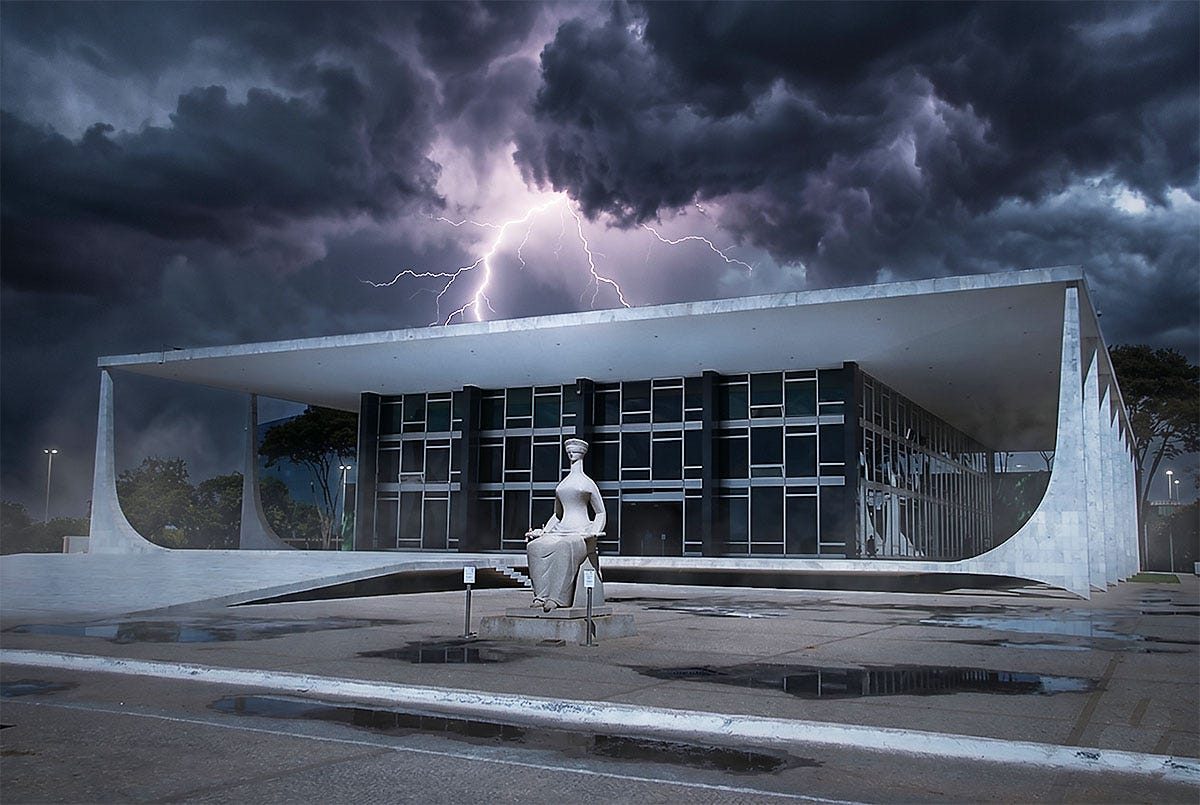
Just a few weeks ago, I wrote about the Supremo Tribunal Federal (STF), Brazil’s highest court. Since then, developments have moved so quickly that the court now feels like a pressure cooker that could burst at any moment. The STF is not only an arbiter of laws, but in practice often the arbiter of political conflicts — and that makes the current situation explosive.
What Makes the STF Different from Other High Courts?
(For readers less familiar with Brazil’s institutional system)
The STF occupies an exceptional position:
- It is both a constitutional court and the country’s highest court.
- It handles criminal cases involving politicians, including ministers and members of Congress.
- It can open, suspend, or take over investigations.
- It plays a direct role in electoral matters.
- And individual justices can issue decisions with immediate national impact.
In many countries, these powers are divided among several institutions. In Brazil, they converge in a single court — and that explains why the STF so often stands at the center of political storms.
A Country That Distrusts the Court — and Depends on It
A new poll by DataFolha, one of the country’s most reliable institutes, once again reveals how contradictory public opinion is:
- 75% believe the STF justices have too much power.
- 71% believe the court is essential for democracy.
A majority also says trust in the court has declined. Political lines matter — Bolsonaro voters are more critical — but strikingly, 64% of Lula voters also believe the justices wield excessive power. The poll was conducted between April 7 and 9, with 2,004 respondents in 137 municipalities and a margin of error of two percentage points.
How the Situation Escalated: A Brief Timeline
For those who haven’t followed events day by day, an overview helps:
- March 2026 – New tensions emerge around the long-running “fake news” investigation, increasingly criticized.
- Early April – The Banco Master case becomes public; Justice Toffoli pulls an investigation into his own chamber.
- April 7–9 – DataFolha releases the poll exposing widespread distrust of the court.
- April 10 – Justice Cármen Lúcia publicly speaks about the need for change within the STF.
- April 11–12 – The president meets with Justice Alexandre de Moraes regarding the Banco Master affair.
- Afterwards – Moraes revives the old ADPF 919, potentially complicating a plea deal by banker Daniel Vorcaro.
- Daily – New leaks, statements, internal tensions, and political reactions.
It is this accumulation that intensifies the sense of instability.
Internal Tensions Break the Surface
Pressure on the court does not come only from outside. Internal cracks are becoming visible as well. During a recent seminar, Cármen Lúcia — the court’s only female justice — said:
“The Supreme Court cannot remain as it is, but it has made efforts to change.”
She pointed to the court’s overload and defended virtual plenary sessions as a way to reduce the backlog — while acknowledging that much remains to be improved. Her remarks were widely reported, including by Estadão.
How Brazilians See It
To illustrate how many Brazilians view the court, I translated a reader’s comment. According to him, the STF itself is the problem: the justices take on too many cases and behave like the “sheriff” of Brazil. He argues that the court should simply refuse more cases, since it alone decides what it will or will not handle. No law can fix this as long as the institution maintains this posture.
As an example, he cites the recent Banco Master case, in which Justice Toffoli took over an investigation that, in his view, should never have reached the STF. He also criticizes the long-running “fake news” inquiry, calling it an endless process in which a single justice acts simultaneously as victim, investigator, police, and judge. Finally, he addresses Cármen Lúcia directly, accusing her of having defended censorship in the past.
New Facts, New Tensions
Every day brings new elements that heighten the sense of instability. Even the president stepped in, speaking with Justice Alexandre de Moraes, who has been mentioned in the Banco Master affair. His wife allegedly received millions through her law firm.
Meanwhile, Daniel Vorcaro — the banker at the center of the case, currently in jail — is considering a plea deal that could implicate high-ranking figures in Brasília, including magistrates. At that very moment, Moraes revived the old ADPF 919, which could hinder such an agreement.
In an interview with ICL, Lula said he had warned Moraes:
“You built a historic legacy with the January 8 trials. Don’t put your own biography at risk because of this affair.”
He stressed that if a justice misbehaves, that individual must be held accountable — not the court as a whole. And he added that anyone who wants to become a millionaire should not be a justice of the Supreme Court.
Political Consequences
These tensions play a significant role in the run-up to the elections. Lula does not want to bear the political cost of missteps by people he has long defended — especially Moraes, whom he sees as a key figure in the response to the events of January 8, 2023.
A Court Becoming Divided
Within the STF itself, clear factions are emerging. The unity the court traditionally tried to project is eroding.
A Boiling Point
The situation surrounding the court now threatens to boil over like milk in a pan: you see it bubbling, you see the edge approaching, but no one knows exactly when it will spill. The distance between the STF and society is becoming increasingly visible. The justices can hardly appear in public without heavy security. That is no normal life, and it reinforces the perception of an institution that has withdrawn behind walls, gates, and protocols.
For most Brazilians, the justices exist only in their robes, in a marble courtroom far removed from everyday life. When they take their seats, attendants slide chairs beneath them — a ritual that has become almost symbolic of the distance between the court and the people. Outside that chamber, they travel the world, give lectures, and are received as honored guests. They are no longer judges in the traditional sense, but public figures who move like celebrities: appearing briefly, waving quickly, and disappearing behind a cordon of security.
That distance is not only the result of circumstances; it is also a product of the court’s own choices. And that is precisely where the tension lies: an institution that plays such a central role in the country’s political and institutional life cannot afford to become unreachable. When a court is powerful, controversial, and insulated at the same time, a vacuum emerges in which distrust grows.
What is at stake, then, is more than a series of legal or political disputes. It is the question of how a democracy deals with an institution that is both indispensable and vulnerable. It is about restoring trust, redefining boundaries, and finding a balance between control, responsibility, and legitimacy. Whether that succeeds depends not only on laws or reforms, but also on the court’s willingness to move closer to the society it serves.
Stay updated. Click below to subscribe — free of charge.