

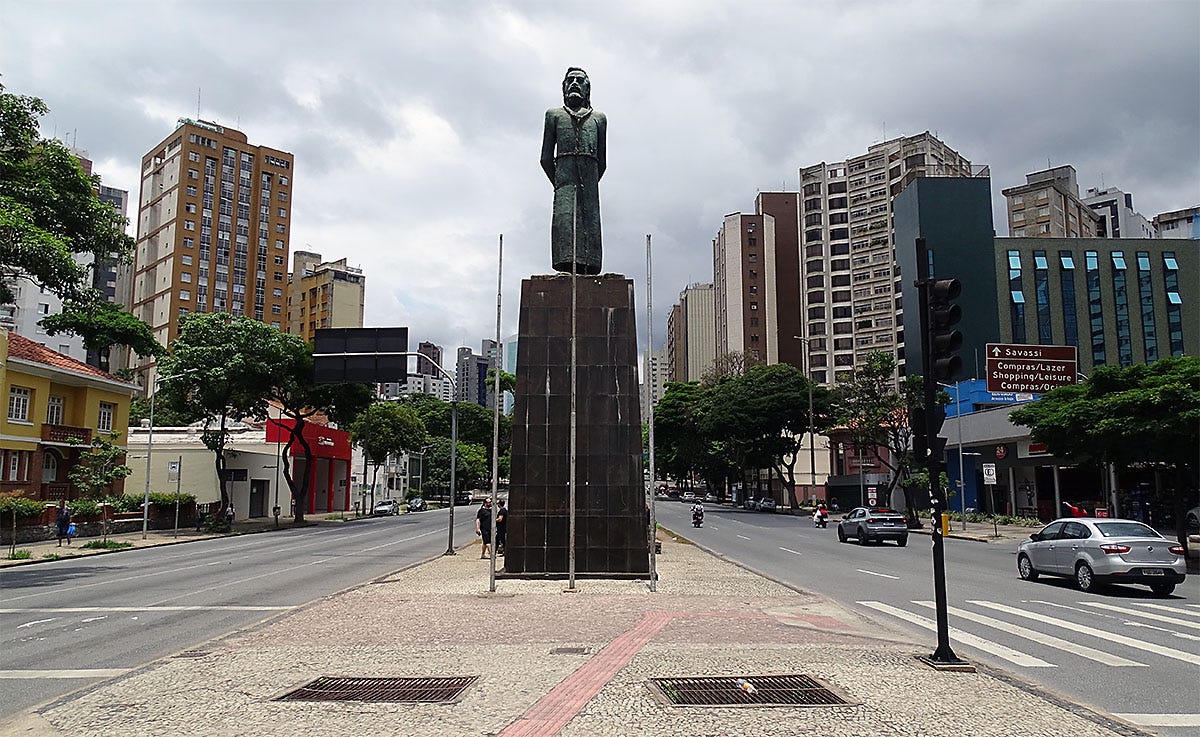
The rush started as early as Friday and was clearly visible on the roads of Brazil. A very long weekend was just around the corner, courtesy of a public holiday—and not just any holiday, but one of national pride. At least, that is how it is supposed to be. However, you can bet your life that many people couldn’t care less; they simply want to reach their destination as quickly as possible to enjoy at least three full days of whatever they are looking for: the beach, nature, or peace and quiet, momentarily forgetting their daily struggles. Besides, it leaves only three days of the working week next week, making it much easier to swallow. Their thoughts certainly don’t wander toward ancestor Joaquim José, even though he met a brutal end. Here is a short story of how that exactly came to pass:
It was an oppressive morning in Rio de Janeiro, that 21st of April in the year 1792. A man with a noose around his neck walked his final meters, surrounded by soldiers and a silent crowd. He was no general, no prince, and no wealthy landowner. He was Joaquim José da Silva Xavier, popularly known as Tiradentes—the Toothpuller. As the executioner prepared his work, no one could have guessed that this simple officer would later become the most important man in Brazil, more significant even than the kings who sentenced him to death.
The story of Tiradentes does not begin on the scaffold, but in the lush, green hills of Minas Gerais. In the eighteenth century, this was the gold mine of the Portuguese Crown. While the gold in the mines slowly ran dry, the tax demands from Lisbon remained relentlessly high. The atmosphere was grim. Ouro Preto was the absolute center of it all at the time. Back then, the city was still called Vila Rica, and it was the capital of the province of Minas Gerais. It was not just any city; it was the beating, golden heart of the Portuguese Empire.
The elite spoke of freedom in backrooms, inspired by the revolution in the United States, but it was Tiradentes who brought the message to the streets. He was a man of many trades: soldier, traveling merchant, and amateur dentist. It was precisely this last profession that brought him into contact with all layers of society. While pulling teeth, he planted the seeds of a revolution.
The conspiracy, known as the Inconfidência Mineira, was fragile, however. In a world of enormous debt, loyalty is for sale. One of the members, Joaquim Silvério dos Reis, decided to betray his friends in exchange for the cancellation of his own tax debts to the Portuguese Queen. The dream of an independent Brazil shattered before a single shot was fired. While the wealthy intellectuals in the group saw their sentences commuted to exile, Tiradentes, as the lowest in rank, was singled out as the ultimate terrifying example.
His execution was a carefully orchestrated spectacle of cruelty. After his hanging, his body was hacked into pieces. The Portuguese Crown wanted to kill not just the man, but also his memory. Even his house was razed to the ground and the soil was sown with salt, so that nothing would ever grow there again.
It is here that history takes an ironic turn. Brazil’s actual independence came thirty years later, in 1822, but in a very unusual way. Instead of a bloody revolution, it was the Portuguese Crown Prince himself, Dom Pedro I, who severed ties with his fatherland and crowned himself Emperor. Brazil was free, but power remained in the hands of the same family that had Tiradentes quartered. For the common people, this independence felt like a palace revolution that had little to do with them.
When Brazil finally became a republic in 1889 and the Emperor was expelled from the country, the new rulers faced a problem. They needed a hero to give their new state some luster, but all the well-known figures were linked to the Imperial House. They dug through the archives and found the file of the Toothpuller from Minas Gerais.
The republicans decided to “rewrite” Tiradentes. Although he likely had short hair as a soldier in prison, they had painters depict him with long hair and a full beard, exactly like Jesus Christ. They turned him into a secular saint, a martyr who was already dreaming of a free republic long before the Emperors did. By honoring Tiradentes, they could frame the independence of 1822 as a mere stepping stone and claim the execution of 1792 as the true beginning of the nation.
Tiradentes has thus become the bridge between colonial suffering and modern pride. Every April 21st, Brazil celebrates not a day of victory, but a day of sacrifice. It reminds Brazilians that their freedom did not begin with the signature of a prince, but with the courage of a man who was willing to lose everything for a dream he would never see become a reality.
While vacationers sit in traffic jams on the winding, dangerous roads of Minas Gerais, where drivers try to outdo each other with high speeds and dangerous overtaking maneuvers just to win those extra hours at the beach or in nature, history repeats itself in a bitter way. The economy grinds to a halt for nearly two days for a man most barely give a thought to.
Back then, without cars or asphalt, the journey between Rio de Janeiro and Vila Rica was a hellish undertaking of days spent traveling through inhospitable terrain. Tiradentes made that journey for the last time in the form of a macabre package: after he was hanged in Rio, his severed head was transported in a salted box to the mountains of Minas to serve as a deterrent on a pole. His arms and legs were placed along the roads where he had preached his revolutionary ideas.
Today, travelers race past him on their way to the long weekend, fighting against the clock and the traffic, while he still looks out over the square from his pedestal in Ouro Preto. He was proven right, and they got their days off. The peace he fought for back then is nowhere to be found on the BR-040, but the freedom to go and stand wherever one pleases—no matter how reckless—is perhaps his most tangible legacy.
Stay updated. Click below to subscribe — free of charge.