

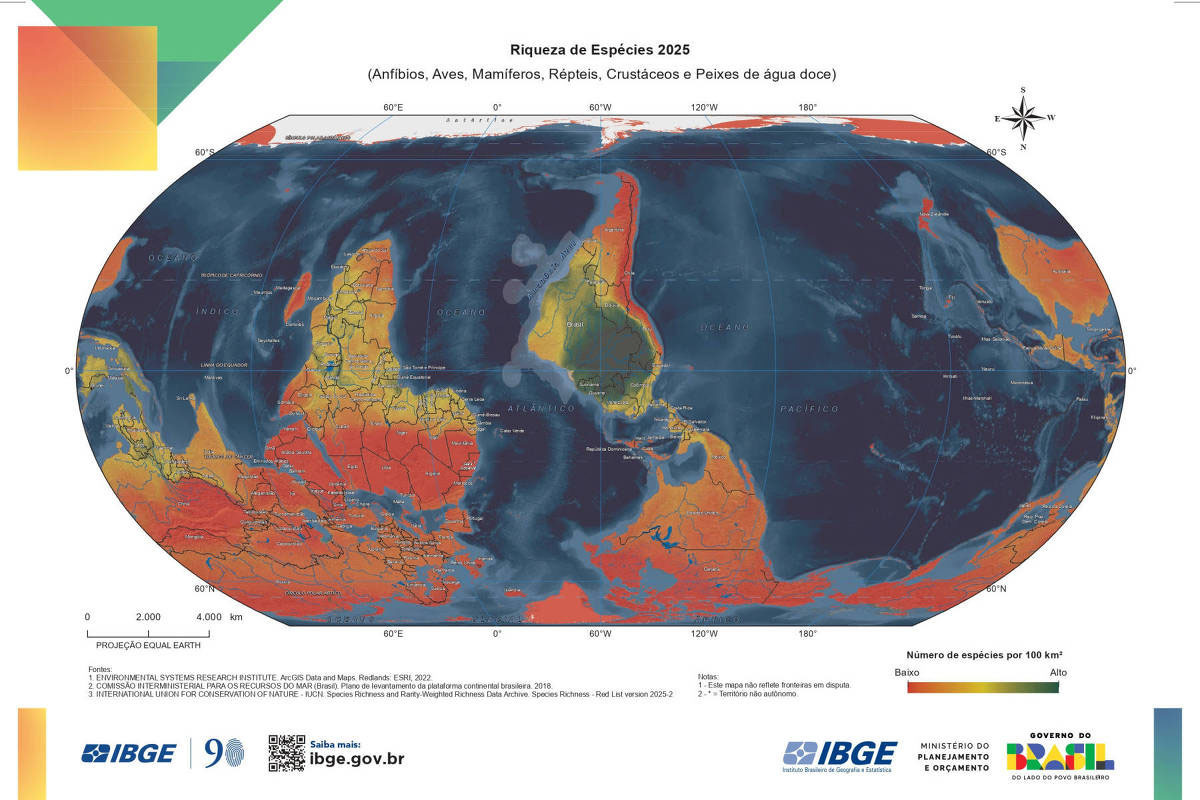
The Brazilian institute IBGE (Instituto Brasileiro de Geografia e Estatística) has once again published a world map that literally turns the planet upside down. Brazil is in the middle, the orientation is reversed, and biodiversity is the starting point. The result is a map that rubs people the wrong way, not just geographically, but also politically and symbolically. And that seems to be exactly the point.
Under the leadership of Marcio Pochmann, an economist with a clear vision of Brazil’s role in the world, the IBGE chooses a projection that breaks the traditional north-south hierarchy. The map is titled Species Richness 2025 and aims to map the earth’s biodiversity. But anyone who thinks this is merely a scientific exercise underestimates the power of cartography.
A map that says more than it shows
The new map projects potential species richness per 100 km² cell: amphibians, birds, mammals, reptiles, crustaceans, and freshwater fish. The Amazon region, in particular, lights up in intense green — a visual cry that makes it clear where the planet’s biodiversity is truly concentrated.
That Brazil stands in the center is no accident but a conscious choice, according to the IBGE. The institute stated that the country “appears central because of its importance in the current social and political context.” A sentence that sounds as neutral as it is loaded. Because who decides what is “central”? And who has decided for centuries what was not?
The IBGE links the launch to the International Day for Biological Diversity on May 22. The message is clear: biodiversity is essential for climate, food security, and health. But the underlying message is at least as powerful: the world can also be viewed differently — and perhaps it even should be.
The recurring controversy around Pochmann
It is not the first time an IBGE map has caused a stir. In 2024 and 2025, maps already appeared with Brazil at the center, though not always in a reversed orientation. Even then, Pochmann was accused of politicizing the institute. He defended himself by stating that the maps should reflect Brazil’s leading role in international forums such as BRICS, Mercosur, and COP30.
Supporters praised the initiative: after all, world maps are not laws of nature but cultural constructions. The Mercator projection — which enlarges Europe and shrinks Africa — is the best-known example. Why shouldn’t a country from the global south be allowed to make a map that shows the world from its own perspective?
Critics, on the other hand, found it inappropriate for a government agency to dive into symbolism. The IBGE is there to produce data, not to make geopolitical statements, they said. The institute replied that it provides “technical and objective information,” not political material. But anyone who knows the history of cartography knows that objectivity in maps has always been an illusion.
Pochmann, appointed by President Lula in 2023, has a tense relationship with unions and researchers within the institute. His style is assertive, sometimes polarizing. But that also makes him someone who is not afraid to challenge long-held beliefs — including the way we look at the world.
A map as a mirror of power
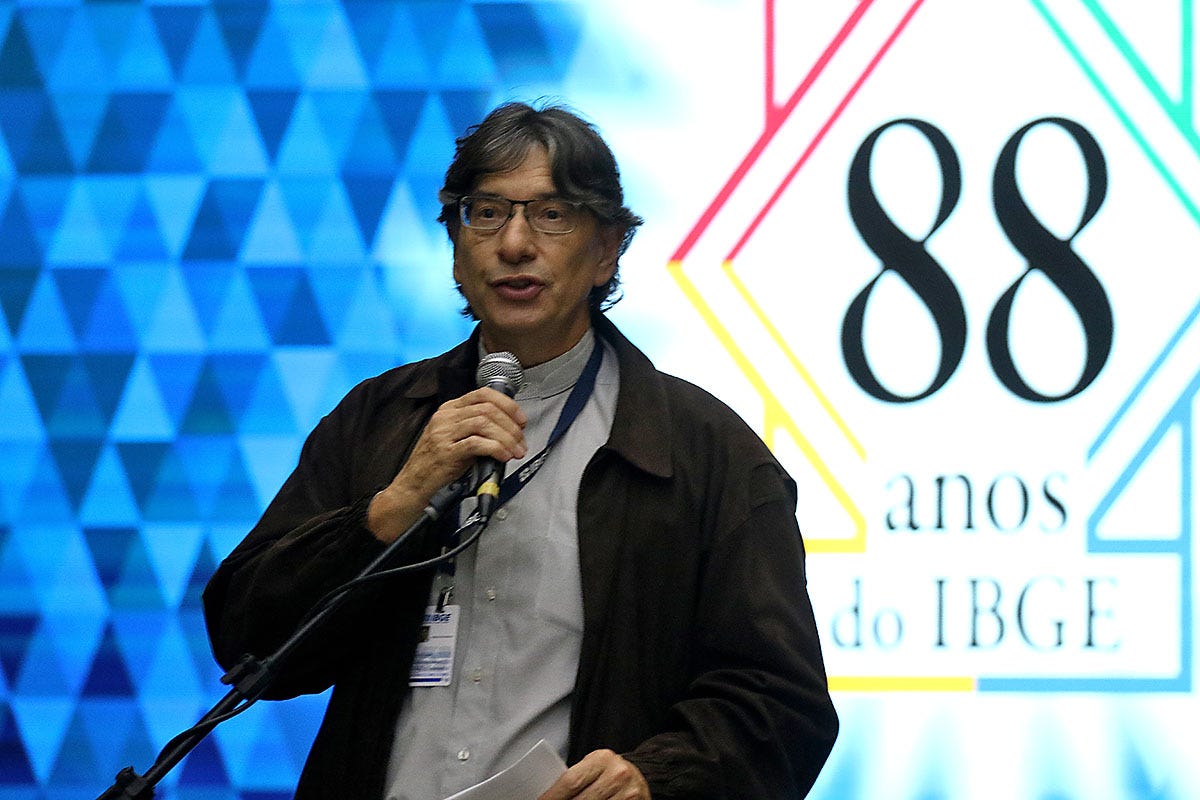
During the launch in Brasília, Pochmann said:
“We are talking about a planet that is not flat and therefore allows for variations in viewpoint.”
That sounds almost trivial, but it touches on a fundamental truth: north, south, east, and west are human agreements. They do not exist in the universe. They do not even exist on the earth itself — only on paper, in our heads, and in our history.
Maps have never been neutral. They are instruments of power, of colonization, of world-building. They determine who stands at the center and who is at the edge. They determine who looks big and who looks small. They determine who is visible and who disappears into the margins.
In that sense, the new IBGE map is not a provocation, but a correction. An attempt to show a “decolonized” world view, as Pochmann calls it. A world where the south no longer hangs at the bottom, but takes a full place in the center of attention.
The discomfort of a different gaze
When you see the map for the first time, you have to blink. It feels strange, almost unnatural. But that says mostly something about how deeply our mental maps are anchored. We are so used to a Eurocentric projection that every deviation feels like an error.
And yet: if you look at the map longer, one thing stands out. Not the position of Brazil, but the color green. The biodiversity that is scarce elsewhere on the planet splashes off the map in South America. The Amazon region is not a detail, but a dominant player in the story of the earth.
If that doesn’t ring a bell, then I don’t know what will.
A map you can buy — and that makes you think
The map is for sale in the IBGE web shop, in Portuguese and English versions. The cheapest costs R$ 25, the most expensive R$ 90 — although reports say the latter sold out quickly. That perhaps says enough: people don’t just want to see this map, they want to own it. Maybe because it is beautiful. Maybe because it is different. Maybe because it says something about the world we live in — and about the world we want.
The map as an invitation
You don’t have to agree with Pochmann. You don’t even have to like the map. But it is hard to ignore that it does something important: it forces us to think about perspective. About power. About biodiversity. About the role of Brazil. About the way we draw the world — and therefore also how we understand it.
Maybe Brazil stands in the middle here by chance. Maybe by strategy. Maybe by pride. But what stands out most is that the rest of the world in this projection is less green, less rich, less full of life. And that is not a cartographic choice, but a reality.
A map cannot change the world. But it can change how we look at the world. And sometimes that is revolutionary enough.
Stay updated. Click below to subscribe — free of charge.