

Not all polls are simple surveys that merely take the pulse of a situation, much like a doctor would. Some polls evolve into a small study—an X-ray of society. These are far more useful than the countless polls that often look exactly like the ones that preceded them. This is the case with the latest Quaest survey, as the results are telling and provide a solid orientation for any candidate, but above all, for the voters themselves.
The classic struggle between Lula and Bolsonaro masks a new reality that is being ignored by both camps. Anyone who wants to emerge as a winner must stop talking about the past and start listening to the “hybrid” voter.
The Quaest study analyzed the voters. They no longer form groups based on terms like Baby Boomers or Millennials. In Brazil, a new division has emerged, as previously described in the book Brasil no Espelho by Felipe Nunes. In this new model, Brazilians can be divided into:
Bossa Nova: The older generation, often conservative in their values, but with a soft spot for social rhetoric.
Ordem e Progresso: The largest group, which places immense value on authority and discipline; the bloc where Bolsonaro achieved his success.
Redemocratização: The backbone of the progressive vote, seeing the state as a protector against inequality.
Geração.com: The core point. The independent digital group that stands above the trench warfare.
This is a subdivision of the electorate based on the era in which they were politically formed: those born between 1945 and 1964 (Bossa Nova), 1965 and 1984 (Ordem e Progresso), 1985 and 1999 (Redemocratização), and between 2000 and 2009 (Geração.com).
There are currently approximately 156.2 million eligible voters in Brazil. The largest portion belongs to the Ordem e Progresso generation at 36%, followed by Redemocratização (29%), Bossa Nova (23%), and the youngest group, Geração.com, at 12%.
The Differences
Ordem e Progresso: Just over 56 million voters, children of the military dictatorship and the so-called “economic miracle.” They were the first Brazilians to grow up with mothers working outside the home and witnessed the explosion of Brazilian rock music. They were the first to see the left (the PT) as a serious competitor and voted for them as well.
Redemocratização: Approximately 45.3 million voters. Born during the period of redemocratization, they grew up in a time of greater hope in the political and economic spheres. They witnessed the expansion of social rights under the governments of Fernando Henrique Cardoso and Lula. Some were born into a world with the internet and mobile phones.
Bossa Nova: 36 million voters who spent their youth or part of their adult lives under the military dictatorship. They were the first generation to enter the labor market under the CLT (Consolidation of Labor Laws), which was introduced during the reign of Getúlio Vargas. They witnessed the rise of Bossa Nova and were the first generation influenced by the entry of women into the workforce.
Geração.com: The first digital generation, estimated at nearly 19 million voters. Their youth was marked by the impeachment of Dilma Rousseff (PT), low economic growth, and the pandemic. They are the children of Bolsa Família and equality policies. They witnessed the resurgence of the right and were the first to live in a context with less formal employment.
This last and smallest group favors entrepreneurship and self-reliance (economically conservative) but wants a modern, tolerant society (socially progressive). For them, polarization is “noise” that hinders their daily progress. They want a manager, not a preacher.
The division between “left” and “right” is primarily related to the zeitgeist in which these people were formed. The strongest base for the left is found in the Redemocratização group. They associate the left with the struggle for civil rights, democracy, and social progress. For them, the state is the protector against inequality; they form the backbone of the progressive vote. The Bossa Nova generation, who grew up in the fifties and sixties, is more often conservative in their values (family, tradition), but they have a soft spot for Lula’s social rhetoric, which reminds them of the “old” Brazil. They can go either way but tend to favor the candidate who guarantees peace and a decent pension. In the current polarization, they often feel displaced.
The largest group, Ordem e Progresso, attaches enormous value to authority, discipline, and patriotism. It is the group where Bolsonaro achieved his success. They often view the left as a source of “disorder” or corruption. Economically, they are often proponents of the free market, but socially, they are very conservative. They form the largest bloc opposing the current leftist government.
Last but not least is the youngest generation, described in Nunes’ book as Geração.com. They grew up with the internet and have no emotional connection to the dictatorship or the PT’s early struggles. They are the least likely to vote based on ideology. They are “right-wing” when it comes to entrepreneurship (wanting to earn their own money via apps and social media) but “left-wing” or liberal regarding personal freedom and the climate. This is the group that Lula does not understand at all. They do not want an ideological narrative; they want a government that makes the Wi-Fi work and opens up the economy. Here lies the opportunity for a Nikolas Ferreira (in the future) or a genuine “third way.” The problem for Lula is that his core (Redemocratização) is smaller than the bloc that naturally leans more toward the right (Ordem e Progresso). The battle for 2026 will therefore revolve entirely around seducing the Geração.com and the undecided voters within Bossa Nova. Together, these two groups constitute a majority of Brazil’s total electorate.
You’re getting older, Dad
The core of the problem for the current government lies in the growing gap between the worldview of the aging president and the daily reality of a new generation of voters. While Lula clings to a political discourse rooted in the 1980s, even the president of the student union UNE admits that the connection with the youth is completely lost. These young people, who form the backbone of the Geração.com, are tired of polarization and the old ideological battle between left and right. They are not looking for a father figure who doesn’t know how a mobile phone works, but for a leader who understands how they earn their living in the digital economy and who recognizes their desire for both economic independence and social stability.
The danger for the left is that this disconnection creates a political vacuum that figures like Nikolas Ferreira effortlessly fill. He masters the language of the screen and social media, allowing him to communicate directly with a group that feels ignored by traditional politics. For these voters, politics is not about long speeches or union strikes, but about fast interaction and relatable values. Ignoring the hybrid preferences of this group—where conservative views on family go hand in hand with a modern, pragmatic outlook on entrepreneurship—is an imprudent strategy that could very well determine the outcome of the upcoming elections in a decisive way.

The Quaest study seems much more important to me than yet another poll where candidate A loses a point to candidate B, or where a new (old) “mustachioed” candidate like Aldo Rebelo* suddenly emerges, causing yet another tiny shift, while candidates C, D, E, etc., complicate matters even further.
Nikolas Ferreira is too young and cannot yet run for the presidency. Among all the others, the best chances go to the candidate who understands their voters and can convince the majority that he or she can meet their aspirations.
Lula might do well to buy a “celular” and ensure he masters this powerful communication tool as quickly as possible. Otherwise, he will never truly understand the messages from the Geração.com, and might find himself facing a text like this: “Pqp presida, mó papo cringe 2.0 kkkkkkkkkk sdds conexão real, o sr tá mt delulu se acha q o hype é o msm de 2002... flp dms! F no chat kkkkkkkkkkkk”. Even the first lady would have a hard time with that one.
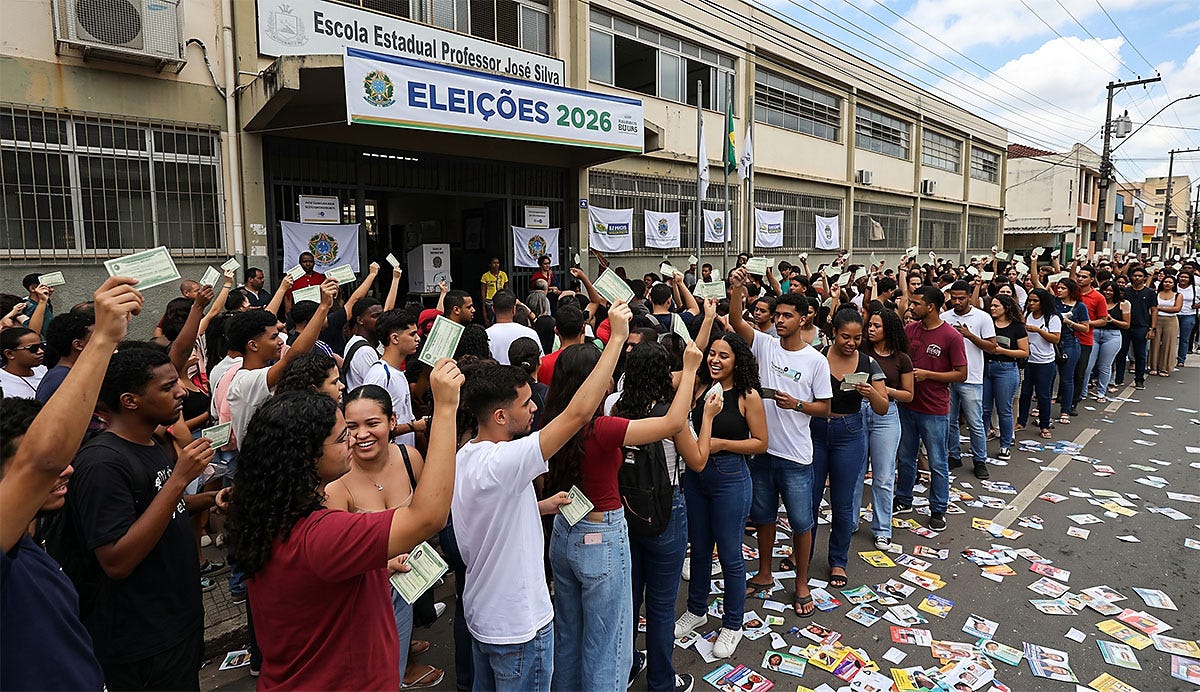
Illustration AI generated - Photo: Facebook
*Former minister Aldo Rebelo (70) confirmed his provisional candidacy for the presidency of the Republic on behalf of the Christian Democratic Party (DC), established in São Paulo in early 2026. Following a leftist background, he is now reaching out to the right, defending nationalist development and legalized mining while criticizing the current government and the activism of the Federal Supreme Court. His average in the latest polls: between 0% and 1%. Should he reach a second round, that average rises to approximately 25% to 29%. As soon as the voter is forced to choose between the “old guard” and an alternative, someone like Aldo Rebelo serves as a rallying point for votes that do not want to go to Lula (or the Bolsonaro family). The fact that he stands at 0% in the first round underscores how difficult it is for a “third way” to step out of the shadow of the major blocs, despite the potential in a direct runoff.
Stay updated. Click below to subscribe — free of charge.