

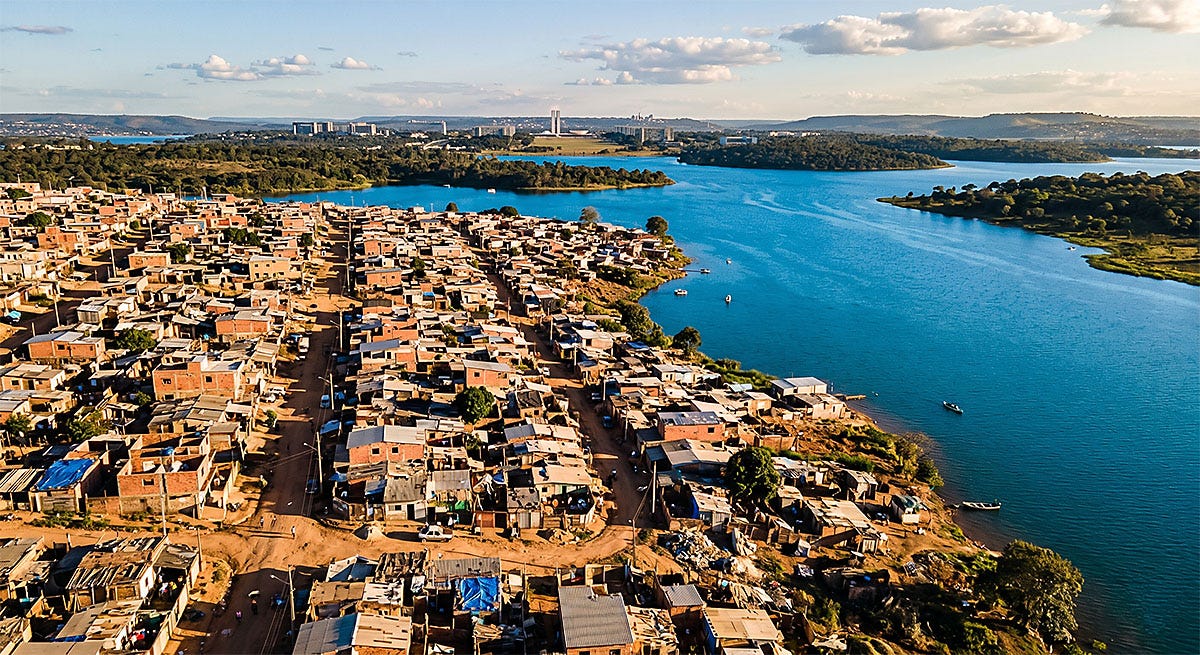
It began with a report from Metrópoles: yet another illegal occupation in the Federal District, this time on the shores of Lake Paranoá — the artificial lake that gives Brasília its air of luxury. An improvised balneário (a kind of informal waterside recreation area), complete with dirt roads, makeshift huts, wooden piers and even luxury cars parked on plots that legally do not exist. The kind of news that leaves Europeans speechless, but barely raises an eyebrow in Brazil.
Because in Brazil, land is never just land. It is history, conflict, bureaucracy, power, hope, distrust and sometimes pure chaos — all at once. And to understand how a group of grileiros can still occupy a piece of land today, build a neighborhood on it and sell it as if it were theirs, you must first understand how property works here. Or rather: how property does not work.
Grilagem — land grabbing through occupation, fraud or simply being faster than the authorities — is not an exotic relic of the past. It is alive and well. The classic grileiro of old forged documents by placing them in a box with crickets (grilos) so the paper would look aged. The modern grileiro uses drones, WhatsApp groups and connections in local government. But the logic remains the same: occupy, build, sell, and hope the government eventually legalizes it. And often, it does.
For Europeans, this is unthinkable. In Belgium or the Netherlands, there is no such thing as no man’s land. Every plot has been registered for centuries. Police arrive within the hour. Illegal construction is halted immediately. But Brazil is different. The country is too large, the state too slow, the history too complex. And that brings us to another typically Brazilian concept: posse.
Posse is not ownership, but it is not nothing either. It means that someone uses, inhabits or works a piece of land without necessarily being the legal owner. In Europe, this would have no legal value whatsoever. In Brazil, it can be stronger than ownership. The law recognizes that those who live, work or produce on a piece of land deserve protection. It is a way of imposing order in a country where paperwork often says less than the reality on the ground. And this leads to situations Europeans find absurd: someone can buy a house, sign all the documents, and still discover that a posseiro lives there who cannot be removed.
And then there is usucapião, the most mysterious concept of all. The idea that you can become the owner of land through time — by using it continuously, peacefully and openly for years. It is a legal instrument designed to regularize reality in a country where ownership is often a historical accident. Usucapião exists in several forms — urban, rural, individual, collective — and it is one of the reasons why Europeans who fall in love with a sítio sometimes end up in a nightmare. Because anyone who thinks that a beautiful piece of land with a pond and a few fruit trees is a simple purchase has not yet understood Brazil.
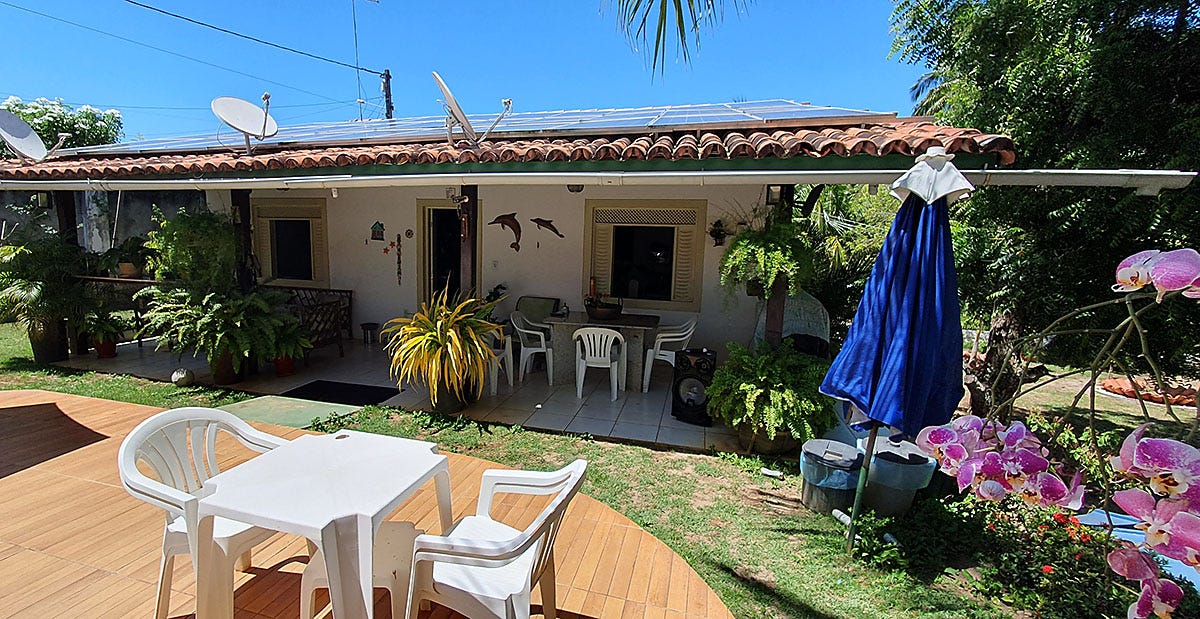
Real estate agents like to say that a sítio brings happiness twice: the first time when you buy it, the second time when you finally manage to sell it. Because a sítio is romantic only as long as you don’t live there. Once you become the owner, the real work begins: roads that wash away, water pumps that break, neighbors who claim part of your land is actually theirs, papers that don’t match, boundaries no one has ever properly measured, and sometimes a posseiro who has lived there for twenty years and refuses to leave. And that is when the adventure truly begins.
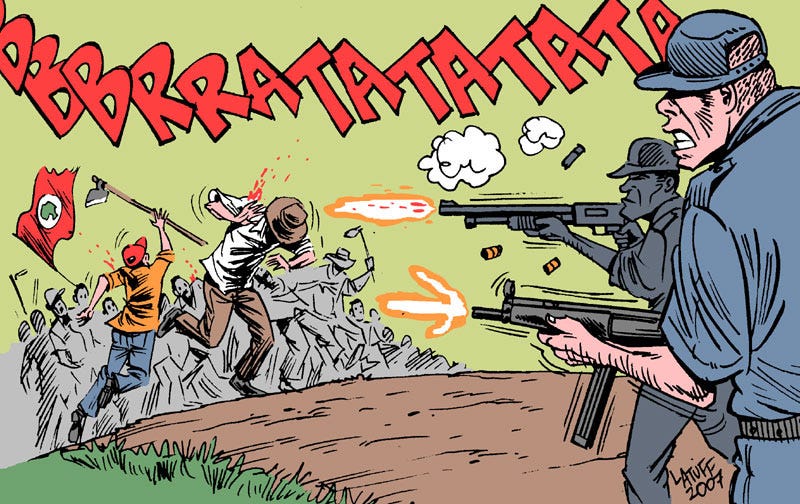
But to understand Brazil, you must also understand the words Brazilians use when they talk about land and housing. A European hears fazenda and imagines a colonial estate with verandas, horse stables and coffee plantations. In reality, a modern fazenda is an agricultural enterprise, often thousands of hectares in size, producing soy, cotton or corn with GPS-guided tractors and drones. It is not a romantic farm, but an agro-industrial operation feeding the global market. Yet the word remains charged, because some fazendas are targeted by the MST, who argue they are “unproductive” and therefore fail to fulfill their social function. This idea has led to violent conflicts, sometimes deadly ones, such as in Eldorado dos Carajás. It also explains why many fazendeiros keep weapons within reach — a mindset openly encouraged by politicians like Bolsonaro and Ronaldo Caiado.
Very different is the sítio, a term Europeans often confuse with a farm, but which in Brazil is primarily a dream object: a small rural retreat, big enough for a pond, a few fruit trees, a chicken coop and a hammock. It is where city dwellers escape to breathe. But buying a sítio also means taking on responsibility: washed-out roads, broken pumps, unclear boundaries and sometimes a posseiro who has been there longer than you. Hence the saying that a sítio brings happiness twice: at the purchase and at the sale.
Smaller still, and closer to the city, is the chácara, a kind of recreational mini-estate, often with a swimming pool, barbecue and garden. It is not farmland, but a weekend refuge. And then there is the puxadinha, a quintessentially Brazilian invention: an illegal extension, an extra room or floor added “quickly,” usually without a permit. In Europe, this would be stopped immediately; in Brazil, it is almost a national sport.
But the puxadinha is only part of a broader building culture that often surprises foreigners: the countless unfinished houses, concrete skeletons, unplastered walls, pillars sticking out as if another floor might be added someday — maybe tomorrow, maybe in ten years, maybe never. People start building as soon as they have a little money, stop when the money runs out, and simply move in, finished or not. Poverty plays a role, of course, but it does not explain everything. There is also a mentality of “building in phases,” of “we’ll finish it later,” of “inside first, outside later.” And the most surprising part is that the interior is often perfectly finished: tiles, ceilings, air-conditioning, a neat kitchen, a modern bathroom. The exterior seems to matter little, as long as the inside is comfortable. The house does not need to look good for the street; it needs to work for the family. It is a different priority, a different logic, a different way of living — and once again something you must understand to understand Brazil.
But anyone who thinks these parallel systems exist only in rural areas is mistaken. In the outskirts of Rio de Janeiro, another story unfolds — just as Brazilian and just as incomprehensible to Europeans. There, it is not the grileiros who control the territory, but the milícias: paramilitary groups formed by former police officers, firefighters and soldiers, who now dominate entire neighborhoods. They build illegal apartment blocks — sometimes ten or twelve stories high — without permits, without engineers, without oversight. They sell the units to poor families who have no other option, and then charge monthly fees for everything: gas, electricity, water, internet, security, even the right to open a shop. Those who refuse to pay are in danger. And when such a building collapses — as happened recently, with fatal consequences — the government eventually intervenes, but by then the damage is done.
The milícias are the urban counterpart of the grileiros: where the state is absent, a parallel authority emerges. And just as in rural areas the boundaries between property, power and violence blur, the same happens in the city — on a scale Europeans can hardly imagine. Buying an apartment in such a neighborhood is not only a financial gamble, but an existential one. You are not just buying a home; you are buying into a system that controls you, protects you and exploits you at the same time.
And so we return to that news report from Brasília. An illegal occupation, an improvised balneário, a government that intervenes but not quickly enough, an investigation underway with no clear end in sight. It is not an exception, but a symptom of a country where property, law, history and power constantly collide. A country where words like grilagem, posse, usucapião, fazenda, sítio, chácara, puxadinha and even milícia are not exotic terms, but mechanisms that determine who may live somewhere, who may build somewhere, who may stay somewhere.
For Europeans, all this is strange, sometimes absurd, sometimes fascinating. But for those who live in Brazil, it is daily reality. And anyone who wants to buy a house here, own a sítio, rent an apartment or pursue a dream must understand this reality. Because in Brazil, land is never just land. It is a story — often a long, complicated and surprising one — that you must learn to read before you begin.